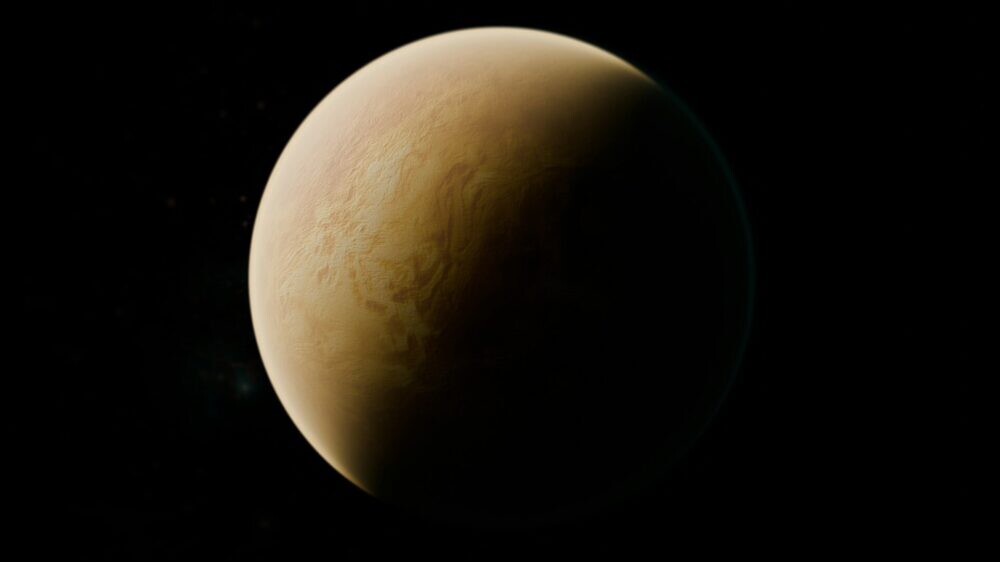




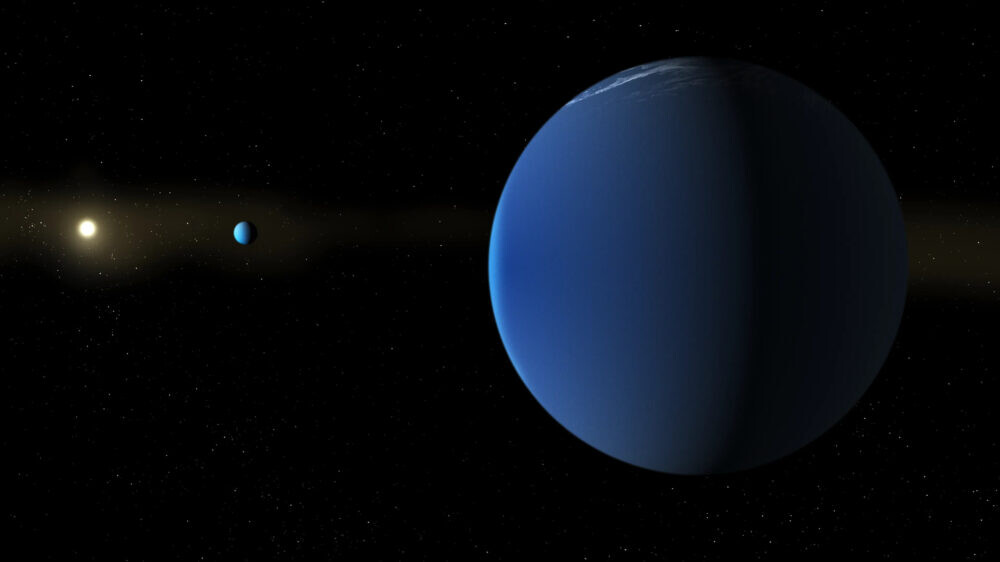

Astronomers from the UK have identified a pair of giant planets the size of Jupiter outside the solar system. They revolve around the star TOI-791, and are called TOI-791 b and TOI-791 c. Despite their size, the celestial bodies have the lowest density ever discovered, notes a study published in the Monthly Notices of the Royal Astronomical Society.
The scientists used the Transit Timing Variation (TTV) method, which analyzes changes in the time a planet passes in front of the star's disk. With its help, researchers were able to calculate the mass of celestial bodies. TOI-791 b is almost the same size as Jupiter, but weighs only 3% of the planet's mass, while the larger TOI-791 weighs only 5.9%.
“The density is extremely low and is comparable to the density of the gas giants from the Kepler-51 system. The mass limits and upper mass limits obtained in this work are reliable for the available data set,” the study results note.
Superpuffs (super-puff can literally be translated as “super-puffy” or “bloated”), or loose gas giants, refer to celestial bodies with enormous sizes and a very sparse structure. Measurements of the star TOI-791 were carried out using NASA's Transiting Exoplanet Survey Satellite (TESS).
According to the US space agency, the celestial bodies are approximately 1,113 light-years from Earth, and their density is “comparable to cotton candy.” At the moment, science knows only a few such planets, and it is even rarer to find two such space objects located within the same star system, says lead author of the study George Dunsfield from the Department of Physics at the University of Oxford.
Low density makes such space objects interesting for studying the formation and evolution of planetary systems as a whole, the scientist adds. A similar position is shared by John Jenkins, scientific director of the Science Data Center at the Ames Research Center in Silicon Valley in California.
“The main reason these planets are so interesting to study is that we didn’t expect to find them at all. “They represent a mystery that we have to solve to understand how giant planets like Jupiter and the superpuffs form,” Jenkins said.
The researchers note that theoretical models describing the formation and subsequent migration of celestial bodies predict different results regarding the mass of planets and their eccentricity, that is, a measure of how similar their orbit is to a perfect circle or an elongated oval. All this allows us to study the origin of space objects.
The appearance of such celestial bodies in space is “a relatively rare result of the process of planet formation,” scientists emphasize. Key questions about the nature and creation of this subgroup of superpuffs remain unanswered, and further research is needed.