



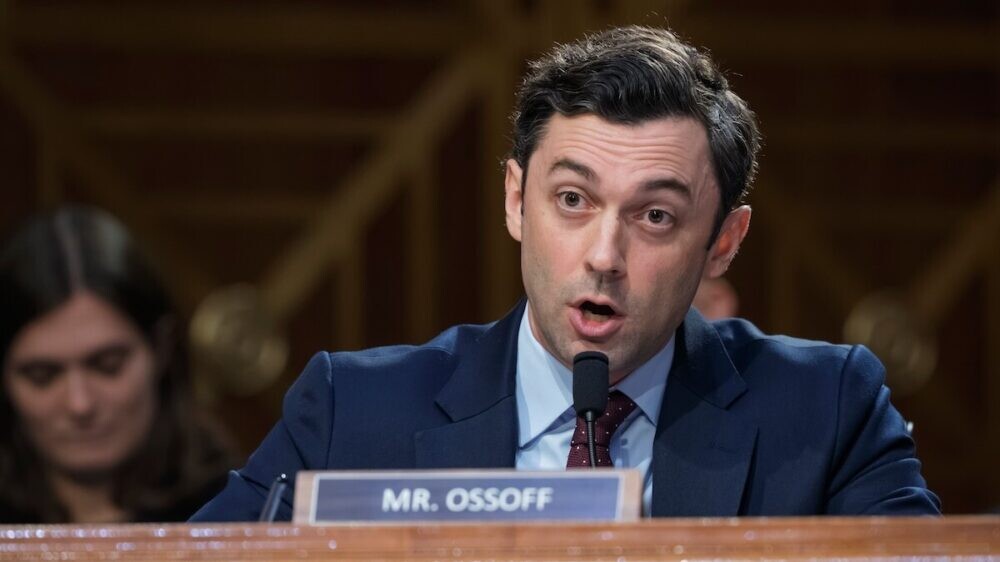

Voting on a bill on new sanctions against Russia and Iran, as well as a number of secondary restrictions, ended in the US Senate on Friday, August 7, with a result of 86-11. The initiative, originally proposed by the late Republican Lindsey Graham and Democrat Richard Blumenthal, was not supported by 1 Republican, 1 nonpartisan senator and 9 Democrats, including Senator Jon Ossoff with Russian roots.
The office of the 39-year-old Ossoff from Georgia, who has recently begun to appear in forecasts about the possible next US president, said that his position is not related to the refusal to support Ukraine, but to the fact that the law gives, in his opinion, excessive powers to President Donald Trump.
“He does not support the provisions of this law that delegate sweeping new tariff powers to the President when he has previously demonstrated that he uses them in a reckless and destructive manner,” representatives of the senator, whose ancestors emigrated from the Russian Empire, responded to Newsweek.
Republican Rand Paul of Kentucky also attributed his refusal to support the initiative named after Graham to opposition to new tariffs. Shortly before the vote, in a column for The Daily Caller, he proposed an amendment that would keep the proposed 500 percent tariffs on Russia in place, but would cut Trump's ability to impose tariffs of up to 100 percent on other countries.
“The drafters of the bill did not realize that it would not bring peace to Ukraine, but would deliberately make American families poorer by increasing tariffs, which are nothing more than a tax on imported goods,” Paul said.
Democrats Lisa Blunt Rochester (Delaware), Maggie Hassan (New Hampshire), Mazie Hirono (Hawaii), Ed Markey (Massachusetts), Alex Padilla (California), Elizabeth Warren (Massachusetts), Peter Welch (Vermont), Ron Wyden (Oregon) and independent Senator Bernie Sanders (Vermont), who is part of the bloc with the Democrats, joined in voting against the new anti-Russian sanctions.
Despite this opposition, the bill received the 60 votes needed to pass. As CNN notes, the final version of the initiative in the Senate included mandatory sanctions against Russian President Vladimir Putin, as well as a number of businessmen, Russian state corporations and foreign companies that the United States suspects in connection with the military-industrial complex of the Russian Federation.
A key feature of the new sanctions is the possibility of introducing secondary measures—duties of up to 100%—against Russia’s trading partners in the oil and gas sector. The size of the duties and the range of these countries, which may include China and India, must be determined by US Trade Representative Jamison Greer.
The new measures will definitely not come into effect until September. To enter into force, the law must be signed by Trump, and before that it must be considered in the House of Representatives, which has gone on vacation.
At Trump's proposal, the bill also included an extension of existing sanctions against Iran, including the country's oil and gas industry. Without appropriate legislation, they could expire at the end of this year.