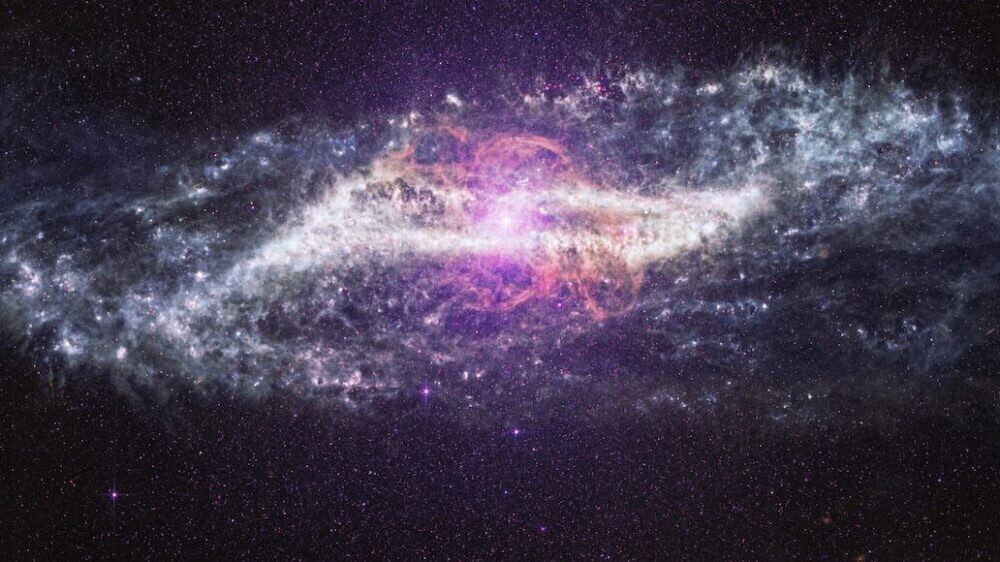

In honor of the fourth anniversary of the James Webb Space Telescope's launch of scientific operations, the US National Aeronautics and Space Administration (NASA) has released new images of the Centaurus A galaxy, located approximately 11 million light-years from Earth. Using sensitive near- and mid-infrared instruments, the telescope captured clear, detailed images of individual stars through dense clouds of cosmic dust.
The unusual structure of Centaurus A was the result of a collision between two galaxies that occurred about 2 billion years ago. This event left behind a large amount of gas and dust – material necessary for active star formation. In addition, the collision provided the supermassive black hole at the center of the galaxy with matter, due to which an active galactic nucleus was formed, reports Space.com.
To celebrate the fourth birthday of the James Webb Space Telescope, NASA has released a stunning image of the strangely shaped galaxy Centaurus A, the site of a cosmic collision 2 billion years ago. https://t.co/HdWHaHNbUy
— SPACE.com (@SPACEdotcom) July 7, 2026
Previously, images from NASA's Hubble Space Telescope in the visible range did not allow the central region of Centaurus A to be seen due to dense dust clouds. The now decommissioned Spitzer Space Telescope, on the other hand, could see large structures using infrared light, but was not powerful enough to capture finer details.
The high resolution of James Webb makes it possible to study Centaurus A at the level of individual stars, including in the central region of the galaxy. Each discovered star helps scientists reconstruct the chronology of the galaxy's development: when older stars formed and when new stars emerged from the gas set in motion by the aftermath of the galactic collision.
“Old stars, younger stars, and stars formed shortly after recent interactions are visible at the same time. All of them provide astronomers with important clues about the history of the galaxy. Much like archaeology, studying these stars can help reconstruct when various events occurred and how the galaxy has changed over time,” NASA says.
The Mid-Infrared Instrument (MIRI), which operates in the mid-infrared range, allowed the James Webb to capture the complex shapes of dust structures. The central region of the galaxy appears to be contained within a parallelogram, and an S-shaped structure can be seen inside it. Many of the glowing red dots in the image are dust-rich so-called “stellar nurseries” where new stars are born.
At the center of Centauri A is a bright active region powered by a supermassive black hole. Powerful energetic radiation indicates extreme conditions deep in the galactic core. James Webb captured fast-moving ionized gas being pushed outward by black hole activity. The telescope also detected warm molecular hydrogen in a warped, rotating disk near the center of the galaxy.
These observations indicate that Centaurus A is an active galaxy, with complex star formation and gas movement ongoing.
“James Webb represents a major step forward, opening a window into new wavelength ranges and levels of detail that were previously unavailable,” said Sean Domagal-Goldman, director of the Astrophysics Division at NASA Headquarters in Washington.