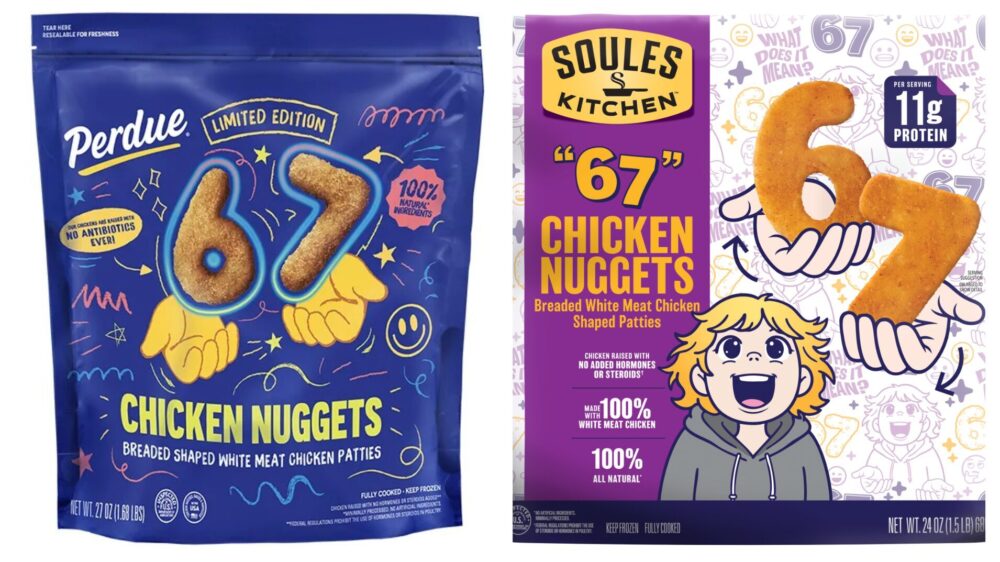

Leading chicken producer in the United States Perdue Foods LLC filed a lawsuit against his competitor John Soules Foods, Inc. The reason was the alleged copying of packaging for frozen nuggets, created based on the “67” (six seven, six seven) trend popular among schoolchildren.
The “67” meme has become popular on the Internet since 2025 and refers to the so-called brainrot – a trend of meaningless jokes generated by artificial intelligence (AI) (literally – “brain rot”). In real life, teenagers began to shout out these numbers while simultaneously raising and lowering their arms, imitating weighing or juggling movements.
There are different versions of the appearance of the meme: from the song Doot Doot by rap artist Skrilla, where numbers appear in the lyrics and may be a reference to the police notice 10-67 about the death of a person, to a TikTok video with basketball players – NBA player LaMelo Ball, 6 feet 7 inches tall, and junior Tylen Kinney, who in the video rated the taste of Starbucks coffee with the phrase “6-7”, raising and lowering his hands.
It was this gesture, along with the numbers, that appeared on the front side of the packaging of nuggets from two companies at once, which became the subject of a dispute about unfair competition. In the suit, Perdue accuses Soules of “false designation of origin, trademark and trade dress infringement.”
“Soules used the designation '67' and a very similar breaded number logo on packaging of frozen chicken nuggets after Perdue launched and nationally promoted its '67' chicken nuggets. At least one major retailer refused to carry Perdue's product because it would have a competing Soules product,” the court documents state.
Perdue announced the launch of its “67” chicken nuggets on April 16, 2026, and they went on sale in Walmart stores nationwide by May 1, according to the statement. The products themselves are also shaped like numbers to “bring a playful twist to mealtimes,” said Chris Perdue, senior vice president of marketing, digital and e-commerce at Perdue.
“It’s one of those phrases that parents can’t get rid of—not in the car, not at school, not at the dinner table. We decided that since this phrase comes up during the meal, let it be on the plate,” Perdue said.
In addition, ahead of the nationwide launch, the company also filed several trademark applications related to the product, including the image of numbers and hand-drawn hands underneath them. The applications were approved and the trademarks are now owned by Perdue Foods LLC.
Meanwhile, Soules Foods, which is owned by the larger Soules Kitchen company, announced it will launch chicken nuggets on June 7, 2026, and said the product will be available in Kroger and Aldi stores nationwide beginning in July.
The company partnered with Maverick Trevillian, a teenager who rose to internet fame after pulling off the trending hand gesture at a basketball game in 2025, earning him the nickname The 67 Kid. He was hired as the head of the MEME department, which literally translates as “meme”, and in deciphering the acronym stands for Mathematical Eats Marketing Executions or “mathematical approach to marketing.”
“To ensure the launch met the highest standards, Soules Kitchen hired The 67 Kid. Trevillian, an undisputed expert in his field, worked with Soules Kitchen for months to ensure that these nuggets were not just beautiful, but also truly satisfying,” notes the press release.
According to the lawsuit, Perdue sent a letter to Soules on June 9 demanding that it stop using packaging featuring the numbers and gesture, but was refused. The plaintiff now demands that all of the defendant's products be recalled, confiscated and destroyed. The case will be heard in the US District Court for the Eastern District of Virginia; an exact hearing date has not been officially set.
Trademark applications that feature packaging that includes a pair of hands have a better chance of success than numbers, Alexandra Roberts, director of the Center for Law, Information and Creativity at Northeastern University School of Law, told The New York Times (NYT).
“You can’t be the only manufacturer of nuggets shaped like 6s and 7s, any more than you can be the only manufacturer of chicken dinosaurs, unicorn mac and cheese, or fish sticks,” Roberts said.
Perdue's requirements, in fact, could then become “a kind of monopoly on the entire category of goods,” she adds. The law on intellectual property does provide monopoly rights, but this applies to patents, and trademarks are not intended for this, the expert emphasized.