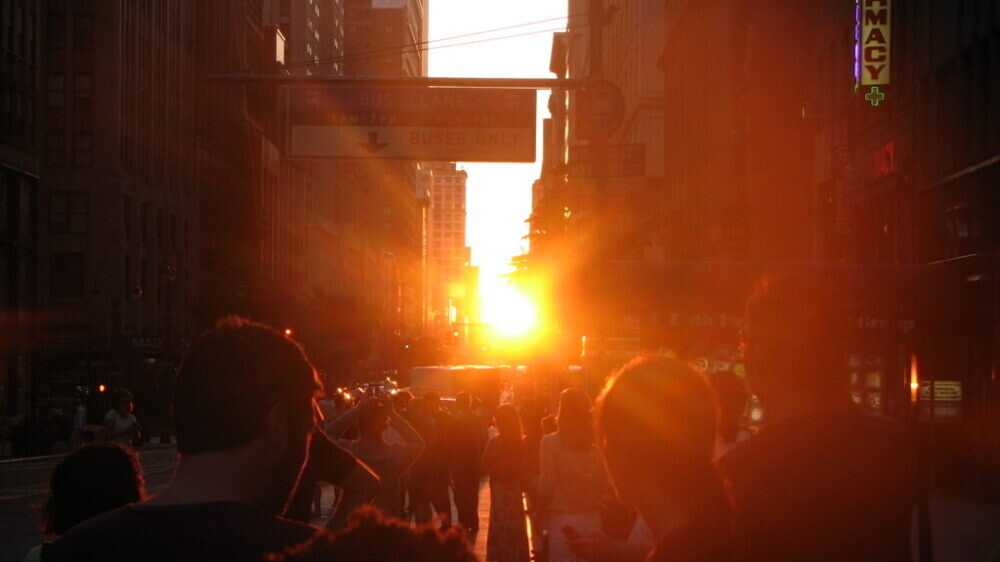

Several times a year, New York's sunset fits perfectly into the downtown street grid. The bright light phenomenon was nicknamed Manhattanhenge by analogy with the ancient British landmark. When and where exactly it will be possible to see the phenomenon in the near future – in the RTVI material.
Manhattanhenge is expected to take place on Saturday, July 11 at 8:20 pm Eastern Time (ET), and on Sunday, July 12 at a similar time. On the first day, you will be able to see the entire disk of the sun setting beyond the horizon between the skyscrapers, and on the second – only half of it. Earlier this year, New Yorkers had the opportunity to view Manhattanhenge on May 28-29.
Astrophysicist and director of New York's Hayden Planetarium, Dr. Neil DeGrasse Tyson notes that the best places to view the phenomenon are from 14th, 23rd, 34th, 42nd and 57th streets. On them you need to select the most eastern points from where you can see New Jersey on the other side of the Hudson River. The sun setting between houses will also be visible on the Tudor City Overpass in Manhattan and Hunters Point South Park in the Long Island City neighborhood of Queens.
Popular spots where spectators take photos and videos can get crowded, so it's a good idea to arrive at least 30 minutes before sunset, Tyson emphasizes. Manhattanhenge can be considered a unique urban phenomenon in the world and, perhaps, even in the Universe, says the famous popularizer of astronomy.
It was Tyson who first compared the phenomenon to Stonehenge on Salisbury Plain in England in 1997. There, the greatest public interest is usually the summer solstice, which fits perfectly into the layout of the stone structures.
Unlike Stonehenge, which was used for rituals thousands of years ago, Manhattanhenge arose randomly in connection with the 1811 New York city plan. Its rectangular grid was intended to maximize the potential for residential development, but ended up being ideally tilted 30 degrees in relation to the north, as well as the changing azimuth of sunset.
For Manhattanhenge to occur, the azimuth must be 300 degrees or 30 degrees north of the west direction. This happens twice: the first time when the sun rises to the solstice point in late May, and the second time after the solstice, when the disk is in the south in early July.
You can see Manhattanhenge not only at sunset, but also at dawn, but to do this you need to wait until the winter solstice. You will be able to see the full morning version of the phenomenon in 2026 at 7:13 am on December 9 and at 7:28 am on January 2, and the partial version at 7:12 am on December 10 and at 7:26 am on January 1 with the onset of 2027.