


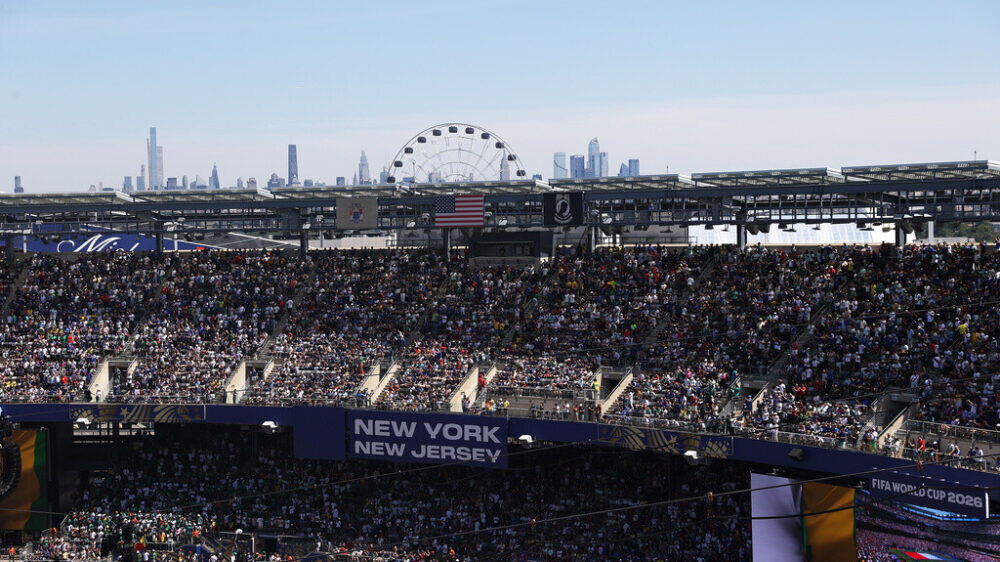

Since the start of the 2026 FIFA World Cup, approximately 50 drones have been intercepted near tournament sites in the United States. reports Reuters with reference to US Secretary of Homeland Security Markwayne Mullin. However, it is not yet known whether any of these drones were equipped with explosives.
According to Reuters, on match days there is a ban on drone flights within a radius of three nautical miles (about 5.6 km) from stadiums and at altitudes up to 3,000 feet (about 914 m). Fan zones also have restrictions, but the no-fly zone is smaller – drones are prohibited from being within one nautical mile (about 1.85 km) and at an altitude of up to 1,000 feet (about 305 m) from the facilities.
The US Federal Aviation Administration (FAA) has warned that drone operators could face fines of up to $100,000, criminal prosecution and confiscation of the aircraft for violating these restrictions.
According to the US Department of Homeland Security (DHS), since June 11, federal officials, together with local law enforcement agencies, have neutralized 55 drones, and another 39 devices have been seized. A total of 145 cases of drone intrusion into closed airspace over eight American World Cup sites were recorded, Politico reports.
Violations were recorded at facilities in Atlanta (Georgia), Dallas (Texas), Houston (Texas), Kansas City (Missouri), Seattle (Washington), Boston (Massachusetts), San Francisco (California) and Philadelphia (Pennsylvania). The statistics did not include sites in Los Angeles (California), Miami (Florida) and New Jersey, although the Federal Bureau of Investigation (FBI) also reported drone activity in these places.
The largest number of incidents was recorded in Atlanta. There were 36 violations of the no-fly zone near sports venues, according to DHS. Of these, 20 were intercepted and 11 drones were confiscated.
U.S. Customs and Border Protection (CBP), the Federal Facilities Protection Service, and the Coast Guard are involved in drone detection and neutralization operations. In addition, specialized units to counter unmanned aerial vehicles have been deployed at eight of the eleven tournament sites.
To control the airspace, radio frequency sensors are used that detect the appearance of a drone immediately after it enters a protected area. By analyzing communication protocols, the system is able to determine the manufacturer and model of the device, establish the data of the registered operator and the launch location of the drone, writes the Los Angeles Times.
Federal services also have radars, acoustic sensors that recognize the characteristic noise of engines and propellers, as well as thermal imaging and optical detection systems.
In addition to monitoring tools, more complex technologies are also used. Some of them allow you to interact with the drone at the level of its own communication protocols, gain control over the device and actually seize control.
Earlier this year, DHS awarded a contract to a company that had developed a specialized interceptor drone equipped with large nets to capture other drones in the air.
On Tuesday, FBI Director Kash Patel said the agency foiled an attack planned for UFC Freedom 250 near the White House. According to him, the attackers expected to use drones equipped with explosives.