




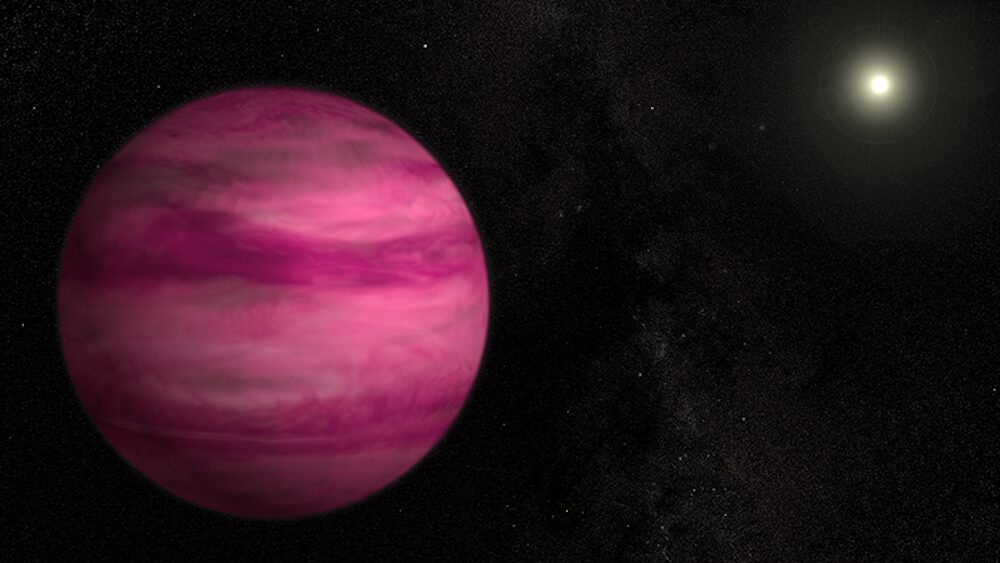

American scientists have discovered an unusual chemical component in the atmosphere of object GJ 504b, known as the “Pink Planet” – salt clouds. The discovery was made during spectral analysis using the James Webb Telescope. The results of the study were published in The Astronomical Journal.
Object GJ 504b was first discovered in 2013, writes CBS News. However, scientists have not yet come to a consensus regarding its nature. It belongs to the category of “planetary mass objects”: it can be either a giant exoplanet or a small brown dwarf – the so-called “failed star”, which at one time began to form, but did not gain enough mass to start the process of thermonuclear fusion in the core.
The “pink planet” orbits a star located approximately 57 light-years from Earth. GJ 504b has a mass of about 25 times the mass of Jupiter and a temperature of about 550 degrees Fahrenheit (about 290 °C). For a giant planet, this temperature is considered extremely low.
Scientists estimate that the object is between 2.5 and 4 billion years old. It is age that explains the relatively low temperature: giant planets gradually cool over time.
Due to its weak radiation, the object remained difficult to observe for a long time. Many research groups have tried without success to obtain its spectrum using the largest ground-based telescopes. However, it only took the James Webb Space Telescope about two hours to detect the emission from GJ 504b and collect the necessary data.
“Previously, astronomers observed this object throughout the night using some of the largest telescopes in the world, but were never able to obtain its spectrum. With James Webb, our entire observing program took about two hours, and we were successful,” said study leader Anish Baburaj of Northwestern University in Illinois.
After recording weak radiation, scientists compiled a kind of “light fingerprint” of the object. Analysis of the spectrum revealed water vapor, methane, carbon dioxide, ammonia and a number of other compounds in the atmosphere. However, the results began to match theoretical models only after the researchers included salt clouds in the calculations. According to Baburaj, modeling taking into account different types of clouds showed that it was salt clouds that best explained the observed data.
“We ran simulations that included clouds, and the results were in good agreement with our understanding of cold planets. We tested three different types of clouds and salt clouds were the best. They weaken the signatures of molecules deeper in the object's atmosphere. After that, the results became plausible,” he said.
The scientist noted that salt clouds occupy an intermediate position between other types of atmospheric clouds. On Earth, clouds are composed of water, on Jupiter they are predominantly ammonia, and on hotter exoplanets clouds of silicates can form. In conditions where it is too hot for water and ammonia clouds, but not hot enough for silicate clouds, clouds of salts can arise.