

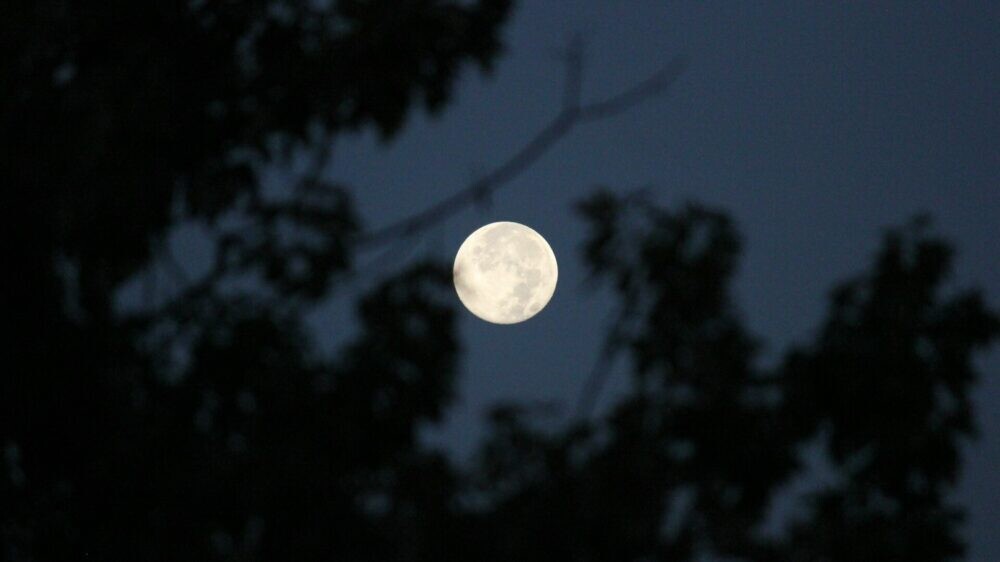

In the coming days, the world will be able to observe a rare astronomical phenomenon – a full “blue” Moon will rise in the sky, which will also become the smallest full Moon of this year. “Blue” moons are the second full moons within the same calendar month—a similar event was last observed in August 2023, Live Science writes.
The Moon will reach its maximum phase for the second time in a month on May 31 at 04:45 US Eastern Time (ET), when it will be exactly opposite the Sun relative to the Earth. For residents of North America, the satellite will appear almost complete on the evening of May 30 above the southeastern horizon, notes the Space.com portal.
This year's Blue Moon will also be a micromoon. This is the name given to the full Moon, which is near its apogee – the point of its orbit farthest from the Earth. The satellite will reach it on June 1 at 00:32 Eastern Time (ET), that is, less than 24 hours after the full moon.
At apogee, the distance from the Moon to Earth will be about 252,500 miles (about 406,400 km). The satellite will appear about 7% smaller than the average full disk, although the difference is too small to be seen with the naked eye. The moon will continue to appear full.
Despite the name, the “blue” Moon does not change its color. During its rising, it will, as usual, have a warm orange hue. The epithet is associated with English-language idioms that characterize extremely rare phenomena.
The term “blue” Moon usually refers to the third of four full moons that occur during one astronomical season. The second full moon of one calendar month is characterized in a similar way. Each of these two events occurs approximately once every two and a half years.
The appearance of two full moons in one month is explained by the discrepancy between the Gregorian calendar and the lunar cycle, which is about 29.5 days. This is exactly how much it takes for a satellite to complete a complete change of phases from new moon to new moon, so if a full moon falls on the first day of the month, there will be another one at the end. There have been cases when two “blue” moons appeared in one year. For example, in 2018 they occurred in January and March, but there was no full moon in February.
According to The Independent, the next micromoon will occur next month, and the next “blue” Moon is expected on December 31, 2028. However, such a rare coincidence, when the “blue” Moon is also a micromoon, will repeat only in 2053.
Astronomy lovers will also enjoy the upcoming full moon with the opportunity to observe Antares, the brightest star in the constellation Scorpio. This red supergiant is located approximately 550 light years from Earth. In addition to the star, Venus, Jupiter and Mercury will also line up on the horizon next to the full Moon.
The first full moon of May was observed on the first day of the month. This Moon is called “flower” – this definition is associated with seasonal phenomena characteristic of North America, where spring flowering is in full swing at this time, RTVI.US previously reported.