


A team of scientists from the USA and Canada, using the James Webb Space Telescope, was for the first time able to capture in as much detail as possible the process of feeding a supermassive black hole in space. Astronomers noted that the hole, during eight hours of observation, sucked in a gas disk stretching over 800 light years at a speed of about 600 km/s.
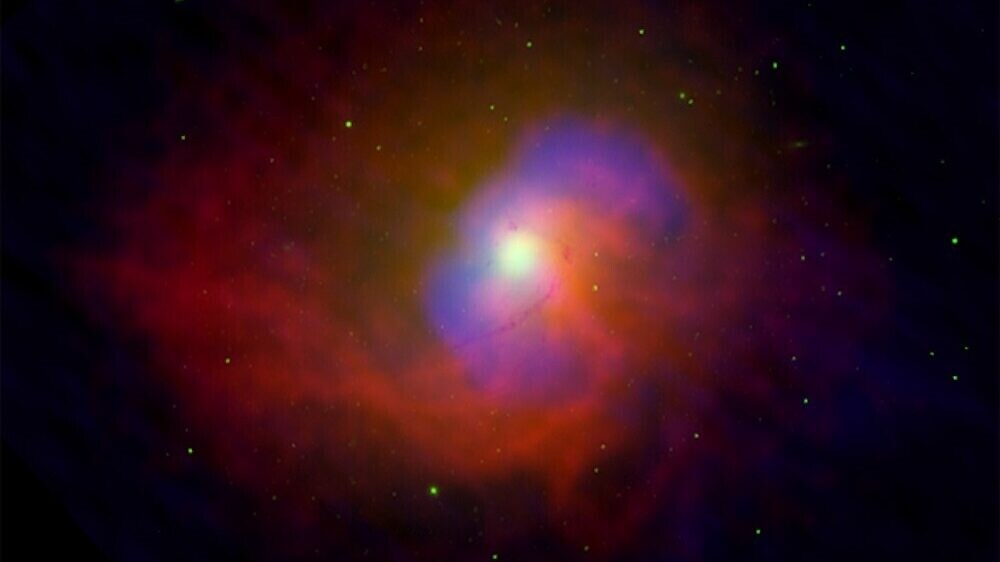
The object of observation was a black hole in the galaxy NGC 4696, central to the Centaurus cluster. It is located more than 140 million light years from Earth.
Based on the images from the James Webb, it was possible for the first time to create a detailed map of the gas disk, which, when pulled in by the black hole, was bent in the shape of the English letter S. As the scientists especially noted, they were able to recognize in the images the threads-filaments that connected the hole with the galaxy. The article was published by The Astrophysical Journal Letters.
“The study helped astronomers create a more complete picture of the supermassive black hole's power cycle. Jets from the black hole pump energy into the gas surrounding the galaxy, after which it cools, loses stability and turns into long filaments – sometimes several hundred light years thick, but thousands long,” notes a Michigan State University press release published by Phys.org.
As the gas approaches the hole, it forms a disk that feeds it, after which it again releases jets to get new “food,” the authors of the work added. The team was able to reproduce the observations using computer simulations by feeding a virtual black hole.
“Calculations by our group at Michigan State University predicted that magnetic fields could power the largest black holes in the Universe if cold gas was directed toward them. It was surprising to see this in the James Webb photographs,” said university professor Mark Voight.