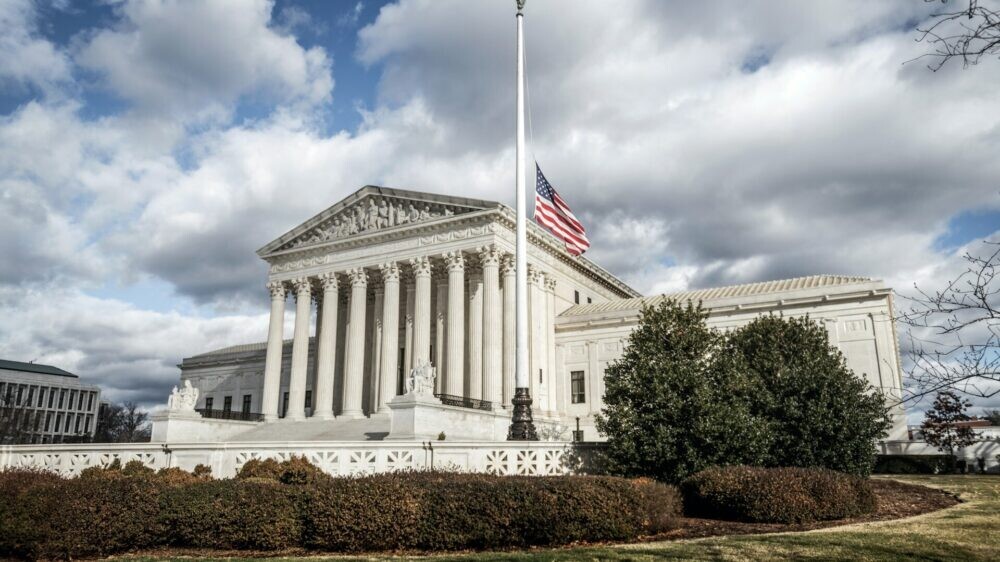

US Supreme Court admitted US President Donald Trump's decree limiting the right to citizenship by birth is invalid. Six of the nine justices opposed the revision of the 14th Amendment to the US Constitution, which guarantees American citizenship to anyone born in the country. How lawyers evaluate this decision is in the material RTVI.US.
Shortly after his inauguration on January 20, 2025, Trump signed an executive order Protecting the Meaning and Value of American Citizenship. According to the document, a newborn can obtain American citizenship only if at least one of the parents is a citizen or permanent resident of the United States. Otherwise, the child is “not subject to the jurisdiction of the United States”—and therefore has no right to citizenship under the 14th Amendment or the Immigration and Nationality Act, which uses similar language.
However, the decree never came into force; after considering a class action lawsuit, a lower court temporarily blocked its implementation. On Tuesday, the Supreme Court upheld the decision. Five judges said the order violated the Constitution and the 14th Amendment, and another judge, Brett Kavanaugh, said Trump's initiative violated federal law. The remaining three members spoke in support of the ordinance. Note that the majority in the court are Republicans, and three of the judges were appointed by Trump himself.
Encouraging illegal migration and “maternity tourism”?
The principle of birthright citizenship is enshrined in the first sentence of the 14th Amendment to the US Constitution, adopted in 1868 after the Civil War. It states that “all persons born or naturalized in the United States, and subject to the jurisdiction thereof, are citizens of the United States and of the State in which they reside.”
The Trump administration has argued that children of undocumented migrants and certain categories of temporary aliens are not subject to U.S. jurisdiction. It has also been argued that the 14th Amendment was originally intended to provide citizenship to former slaves and their descendants, and the broader interpretation is out of context.
Justice Samuel Alito, who sided with the administration's position, said the amendment's current interpretation encourages illegal migration and called the principle of soli citizenship “medieval.” During the hearings, it was also alleged that tens of thousands of foreign citizens come to the United States for the purpose of so-called “maternity tourism.”
The court confirmed the established legal interpretation based on the precedent in United States v. Wong Kim Ark (1898). It was then established that citizenship by birth also applies to children of foreign citizens. Chief Justice John Roberts stressed that there was no reason to deviate from this practice.
Immigration lawyer Alex Tovarian called the court's decision “a great victory for democracy” and an indicator that “the Constitution remains the main document in this country.”
“Does this Supreme Court decision mean that Donald Trump has become weaker in the eyes of the judges or that he is automatically losing ground? No. This means that his power, as in any democracy, has limits, even, mind you, with a conservative Supreme Court. This means that judges remain independent in their decisions. They showed that the president cannot change the meaning of the Constitution by executive order,” Tovaryan said.
Political science professor Ron Heyduk from the University of San Francisco (California) regarded the outcome of the case as a failure of Trump's immigration policy.
“His war on immigrants continues to cause untold harm to millions of people whose situations remain precarious because of barriers to legal status. We need comprehensive, rights-based immigration reform to ensure equal treatment,” Hejduk said.
According to ABC News, if the order went into effect, about 255,000 children each year would lose their legal status as citizens.
After the court's decision, Trump jokingly congratulated China and Chinese President Xi Jinping “on their huge victory in birthright citizenship.” He called the Supreme Court's decision “very bad” and said it could be circumvented by passing federal legislation in Congress without “long and cumbersome constitutional amendments.” Trump called on Congress to immediately begin working to abolish birthright citizenship.
“Congress must begin working today to end birthright citizenship, which is costly and unfair to our country. They will have my full and unconditional support!” – Trump wrote.
Tovaryan noted that after such a “legal battle,” obtaining approval from both houses of Congress looks unlikely.