




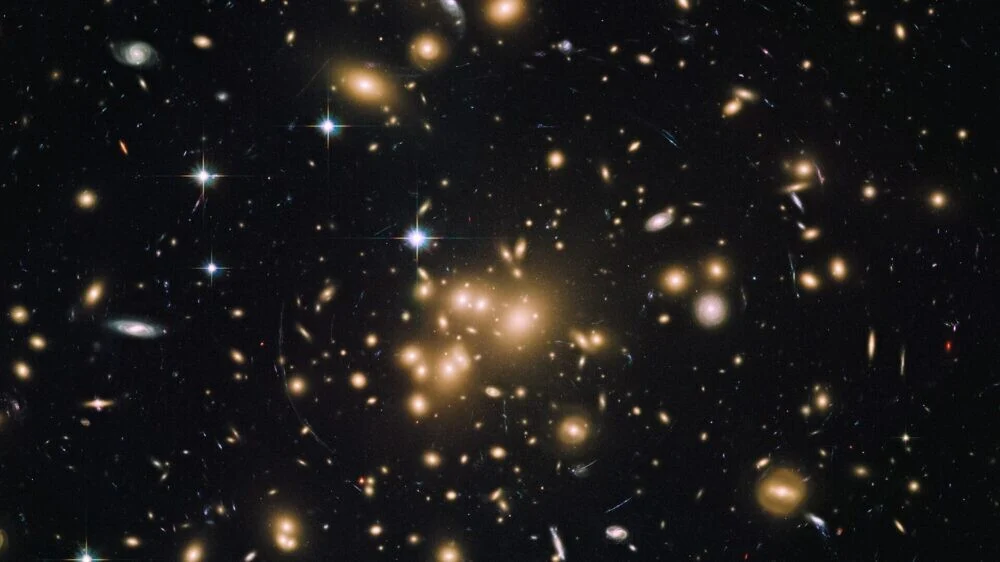

A team of astronomers led by scientists from Yale University (USA) has discovered a third galaxy devoid of dark matter – a hypothetical invisible substance that, thanks to its gravity, keeps star systems from falling apart. The object, named NGC 1052-DF9 (or DF9), is located approximately 67 million light-years from Earth and is part of a previously unknown linear structure of galaxies. The results of the study were published in The Astrophysical Journal.
Dark matter serves as a gravitational “scaffold” that gathers gas, dust and stars together. It does not absorb, reflect or emit light, so it cannot be seen. Scientists judge the existence of this substance by its gravitational effect on visible objects. Dark matter is estimated to make up about 27% of the universe and is about six times more massive than ordinary matter.
To study DF9 in detail, the researchers used the Keck Cosmic Web Imager (KCWI) spectrograph installed at the observatory on the summit of the Mauna Kea volcano in Hawaii.
By measuring the speed of the stars inside DF9, scientists determined that the total mass of the object is about 100 million solar masses. This is consistent with the amount of visible matter for a galaxy of this size and does not indicate the presence of any foreign matter. If DF9 contained the usual amount of dark matter for such objects, its mass would exceed 10 billion solar masses.
“The exceptionally high precision of KCWI allowed us to measure DF9’s extremely low mass with the necessary precision and confirm the almost complete absence of dark matter,” said study author, astrophysicist Michael Keim of Yale University.
The DF9 galaxy is located next to two other similar systems, DF2 and DF4, which also contain little or no dark matter. According to the researchers, all three objects could have formed simultaneously as a result of one powerful event. The most likely scenario is considered to be a high-speed collision of two galaxies, during which gas was separated from dark matter – from which individual galaxies subsequently emerged. Such a linear system has never been observed before.
“Almost every galaxy in the Universe is dominated by dark matter. DF2, DF4 and now DF9 have proven to be unusual exceptions. “These data provide some of the strongest evidence to date that these galaxies formed together in a powerful event that separated ordinary matter and dark matter,” Keim added.
The discovery could significantly affect ideas about the formation of galaxies and the nature of dark matter. It confirms earlier research by astronomer and study author Pieter van Dokkum on the galaxies DF2 and DF4, which indicated that dark matter is a distinct form of matter rather than an effect of gravity.
“Until now, it was believed that galaxies form inside massive dark matter halos. However, this system shows that under extreme conditions, stars and galaxies can arise outside such halos. In addition, the results indicate that dark matter is a real physical substance, capable of existing separately from ordinary matter and gas. This calls into question alternative theories that view dark matter as an effect of gravity,” Keim said.
The researchers are now continuing observations using other telescopes, including the new Mothra device. They expect to detect remnants of gas that could have been preserved after the supposed collision of galaxies.