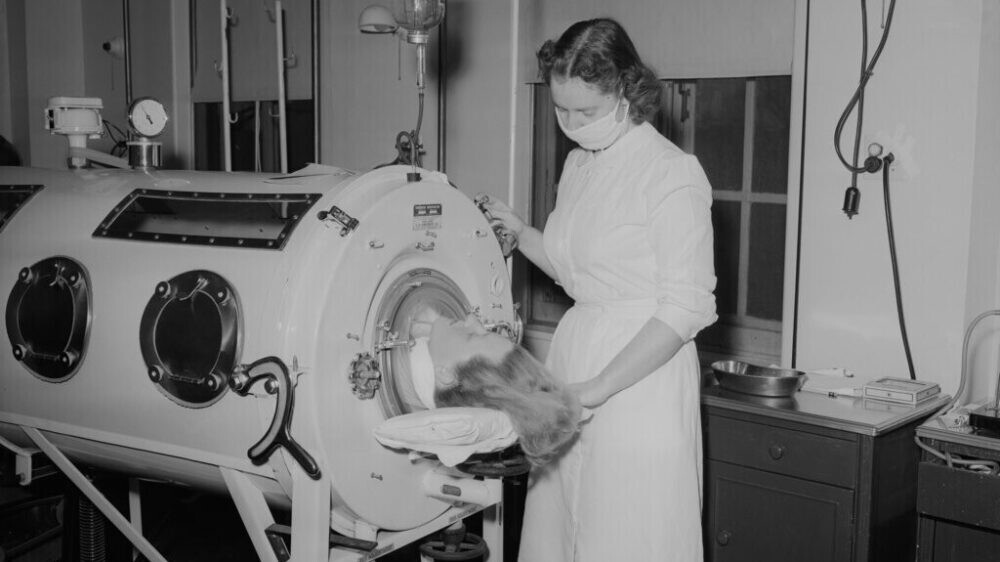

Martha Lillard has died at the age of 78, the last American woman to use an outdated machine called an iron lung for the rest of her life after suffering polio as a child, NPR reports. Today, such medical equipment is not used in clinical practice: mass vaccination against polio, which began in the United States in the mid-1950s, helped stop the spread of the disease, and technological developments over time led to the emergence of more advanced ventilators.
Lillard contracted polio at age 5 in 1953, two years before the vaccine became available in the United States. At the time, doctors often used iron lungs to help patients cope with breathing problems due to the disease.
“Usually they didn’t like to put children there because they resisted, but I didn’t. I liked it. It felt good to breathe again,” she told KFOR-TV a week before her death.
After suffering the infection, Lillard slept on the machine every night. As a child, she was almost constantly inside an iron lung and could only attend school for one hour a day. Later, when her condition improved, she began to use the device only at night, while sleeping. Since adolescence, Lillard could already climb in and out of the device on her own, KFOR-TV reports.
When more modern breathing support devices became available, Lillard did not want to give up the iron lung. None of the new developments could provide the pressure she needed, she said.
“I tried everything. “No machine could provide the 21 psi pressure I needed to breathe, so they just weren't helping,” Lillard said.
Over time, the old device began to fail. Some of its parts were manufactured by Chevrolet in the 1940s, making replacements extremely difficult to find. It was no less difficult to find a specialist who could install, for example, a spare engine.
Lillard died after a long battle with the effects of COVID-19. She suffered from coronavirus infection twice, then fell ill with shingles. In the last months of her life, she spent almost all day in the iron lung.
The device operated on the principle of external ventilation with negative pressure. The patient lay down inside a large metal chamber equipped with a pump that alternately decreased and increased the pressure inside the device. As air was pumped out, the pressure decreased, the chest expanded, and air entered the lungs through the nose and mouth. Then the pressure increased again, and the air left the lungs.