
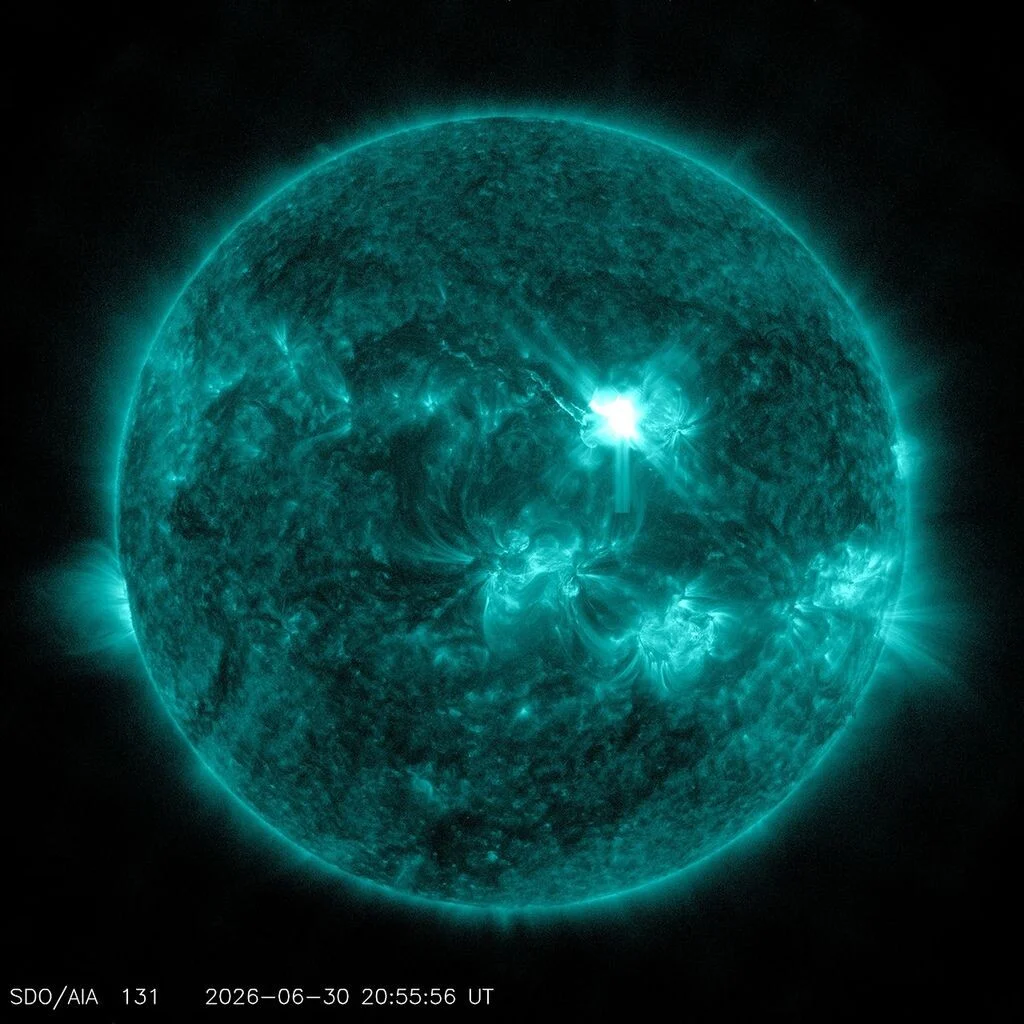
A solar flare of class X1.1., the highest in classification, was recorded on the Sun. It peaked on Tuesday around 4:50 pm ET and has already caused radio outages in North America. Such phenomena can also cause interference with satellite communications and navigation systems. In addition, after a powerful flare, scientists do not rule out magnetic storms in the coming days.
The image of the flare was published by NASA's Solar Dynamics Observatory. The flash itself can be seen in the above image just above and to the right of center. It shows a piece of ultraviolet light that emits extremely hot material and is colored turquoise.
NASA/SDO
At the same time, Russian scientists report that they recorded 17 outbreaks in one day, but they did not reach level X.
Despite reports on social networks about a possible “strongest magnetic storm,” official forecasts from the US National Oceanic and Atmospheric Administration (NOAA) have not yet confirmed the scenario of an extreme geomagnetic storm on July 1-2. According to the Space Weather Prediction Center (SWPC), as of July 1, there is only a warning for a G1 level geomagnetic storm, which corresponds to a weak level of disturbance in the Earth's magnetic field. This level is considered weak and usually leads to only minor fluctuations in the operation of power systems, satellite navigation and radio communications.
The NOAA warning system divides space weather events into three categories: R – radio blackouts, S – solar radiation storms and G – geomagnetic storms. Danger levels range from 1 to 5, with G1 considered a minimal storm level and G5 an extreme storm level.
However, the recorded X1.1 class flare has already caused radio communications disruptions in North America, Space.com reports, citing SWPC data. According to American meteorologists, the outbreak led to a radio blackout at level R3 on the NOAA scale, which is considered a high impact level. The most notable disruptions affected high-frequency (HF) radio communications used by aviation services, sailors, amateur radio operators and some emergency services. In certain areas of North America, temporary signal deterioration and short-term disruptions in communication were recorded.
Solar flares are powerful bursts of electromagnetic radiation that occur when magnetic energy is released in active regions of the Sun. X-rays and ultraviolet radiation reach Earth in about eight minutes—almost at the speed of light—and impact the upper atmosphere, increasing ionization. This is what can lead to the weakening or temporary disappearance of shortwave radio signals.
Scientists are also tracking whether the flare was accompanied by a coronal mass ejection (CME), the ejection of charged particles and plasma into space. It is precisely such emissions that can cause magnetic storms on Earth.
According to preliminary data, the outbreak was indeed accompanied by a CME, but the bulk of the ejected material is moving north of the Earth's trajectory. Nevertheless, experts do not rule out a so-called “glancing blow” on the planet’s magnetosphere around July 3.
If some of the solar plasma does reach the Earth, a magnetic storm of weak or moderate strength is possible. This could cause additional interference with satellite communications, GPS navigation and power systems, as well as increase the likelihood of the northern lights appearing in more southern latitudes.
At the same time, solar activity does not pose a direct threat to people on the Earth’s surface—the planet’s atmospheric and magnetic fields continue to effectively protect it from most solar radiation.