


This year, the United States is hosting the World Cup and celebrating the 250th anniversary of the signing of the Declaration of Independence. Interestingly, 50 years ago, in 1976, on the occasion of the country's 200th anniversary, the United States also hosted an international football tournament.
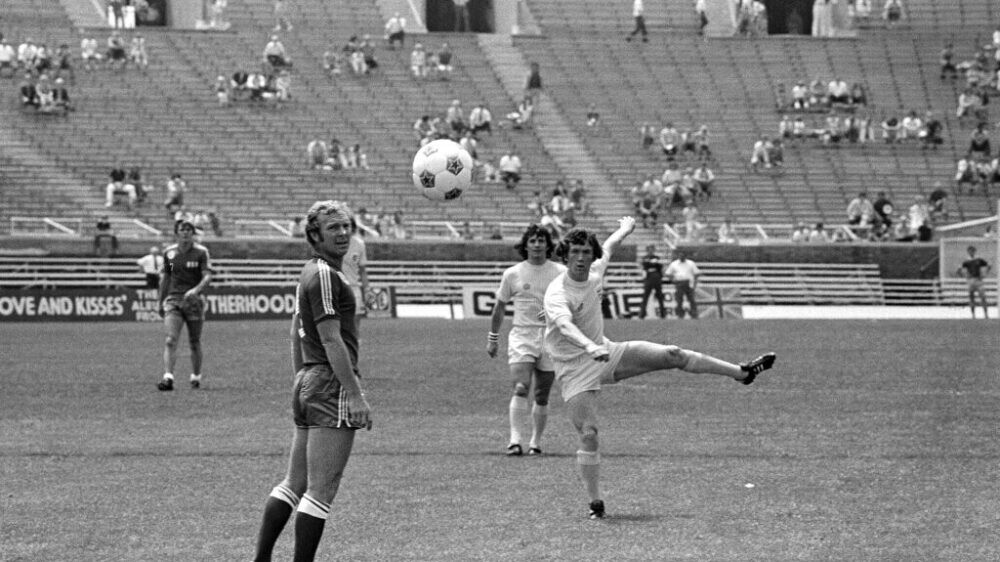
The tournament was not of this scale back then. It was called the USA Bicentennial Cup, that is, the US Bicentennial Cup. Four teams took part in it: Brazil, England, Italy and a team called Team America. The USA's own national team was so weak at that time that competition with the three-time world champions Brazilians or the finalists of the last championship, the Italians, was excluded. Therefore, the organizers took an unconventional step: they formed a team of the best foreign players who played in the North American Soccer League (NASL), adding several Americans to them for a formal connection with the host country.
Team America's lineup looked like a team of international stars. It included the legendary Pele, Northern Irishman George Best, Englishman Bobby Moore, Italian Giorgio Cinaglia, Peruvian Ramon Mifflin and other famous football players. The American press dubbed this team the “Melting Pot”.
At the same time, the status of the matches with her participation remained ambiguous. The English Football Association refused to recognize the game against Team America as an official international match, considering it a training match, while the federations of Brazil and Italy included these matches in official statistics. Pele himself, a Brazilian by birth, refused on principle to take the field in a match against his native country. In an interview, he explained that he would never play against Brazil, and the organizers were understanding of his decision.
The tournament took place from May 23 to May 31, 1976 at six stadiums in different cities. The results were predictable. Brazil won all three matches to emerge victorious, England finished second, Italy third and Team America finished without a point, scoring just one goal and conceding nine. The defeats were devastating: 0:4 from Italy, 0:2 from Brazil, 1:3 from England.
However, athletic results were far from the main thing. The tournament had a different purpose. As US Soccer Federation President Gene Edwards said, these competitions were supposed to be a “big test” and show whether the country is ready to host a World Cup in the foreseeable future. And the plan worked. Eighteen years later, in 1994, the United States hosted the World Cup, which set attendance records (an average of 69 thousand spectators per match) and launched the professional league MLS.
In 2026, the situation is radically different. Instead of four teams – 48 teams, instead of six matches – 104, instead of six stadiums – 16 host cities in three countries. And if half a century ago, Americans had to assemble a team of foreigners in order to somehow compete, now the United States has its own team with players from top European clubs and a world-famous coach.
Football itself in the United States over these decades has ceased to be a marginal phenomenon. Today MLS has 30 teams, the average attendance is about 23 thousand spectators per match, 18 of the 50 most expensive football clubs in the world are located in the USA. Football has overtaken baseball in popularity and ranks third after American football and basketball. The main change has occurred in the audience – 76% of football fans in the country are people under 40 years old. That is, football has become a youth and fast-growing sport.
Thus, in 1976, football was something of an alien sport for America, which they tried to adapt to local realities. In 2026, the World Cup became part of the big anniversary agenda.