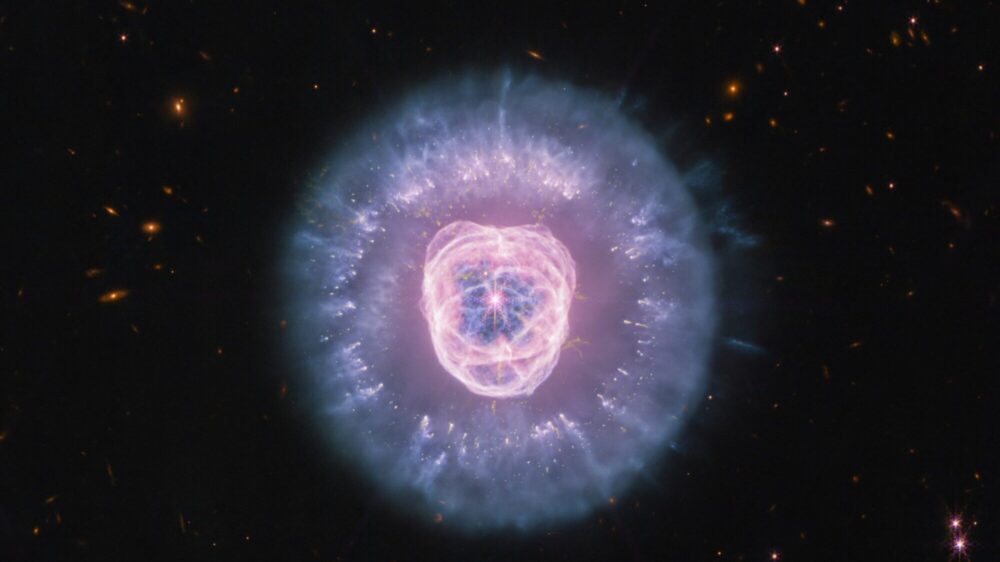

The National Aeronautics and Space Administration (NASA) has released new images of the Leo Nebula with a dying star at the center. The resulting images allow us to view the structure of the nebula with detail previously unavailable to astronomers thanks to two instruments of the James Webb Space Telescope – the NIRCam (Near-Infrared Camera) camera and the MIRI (Mid-Infrared Instrument) camera.
The nebula NGC 2392 was first discovered by astronomer William Herschel in 1787. It is located approximately 5,000 light years from Earth in the constellation Gemini. For a long time, the object was known as the Eskimo Nebula.
In 2000, the Hubble Space Telescope obtained the first detailed image of the nebula, in which its structure began to resemble the head of a lion. New data from the James Webb revealed even more details, including compact clumps of dust and clouds of ionized gas.
The nebula is located in the center of the frame, has a round shape and resembles the head of a lion. In the very center there is a small white dot with eight diffraction rays – this is a dying star. It is surrounded by ring-shaped shells. Together they form an oval structure with two small, wide arches at the top, reminiscent of the face and ears of a lion. Around the “muzzle” there is a thick ring of purple-blue substance, similar to a mane.
It's the circle of life…
Webb's look at the Lion Nebula, the remains of a dying lower-mass star, is in both the mid and near-infrared. Though massive stars undergo supernova explosions at the end of their lives, lower-mass stars shed their outer layers. pic.twitter.com/9dmHxUlHio
— NASA Webb Telescope (@NASAWebb) August 10, 2026
The nebula's unusual structure is associated with the evolution of the star at its center – a white dwarf. High-mass stars explode as supernovae at the end of their lives, but such events are relatively rare. Most stars in the Universe are small to medium-sized objects, like the star at the center of NGC 2392.
When low-mass stars are no longer able to sustain thermonuclear reactions, they begin to pulsate, gradually shedding their outer layers. The ejected material forms a surrounding shell of gas and dust – this is how a planetary nebula arises.
However, not all of the dust ejected by the star reaches the outer regions of the nebula: a significant part of it is destroyed under the influence of radiation. The surviving particles eventually become part of the interstellar dust that we observe in the Universe.
As gas and dust continue to move away from the dying stellar core, the lion's appearance will gradually change. Astronomers estimate that in about 10,000 years the matter will finally dissipate into outer space.
New data from James Webb will help scientists better understand how small and medium-mass stars complete their evolution, shed their outer shells and enrich the surrounding space with gas and dust.
The process of destruction is a normal stage in the evolution of stars – the Sun will also go through this in the future.