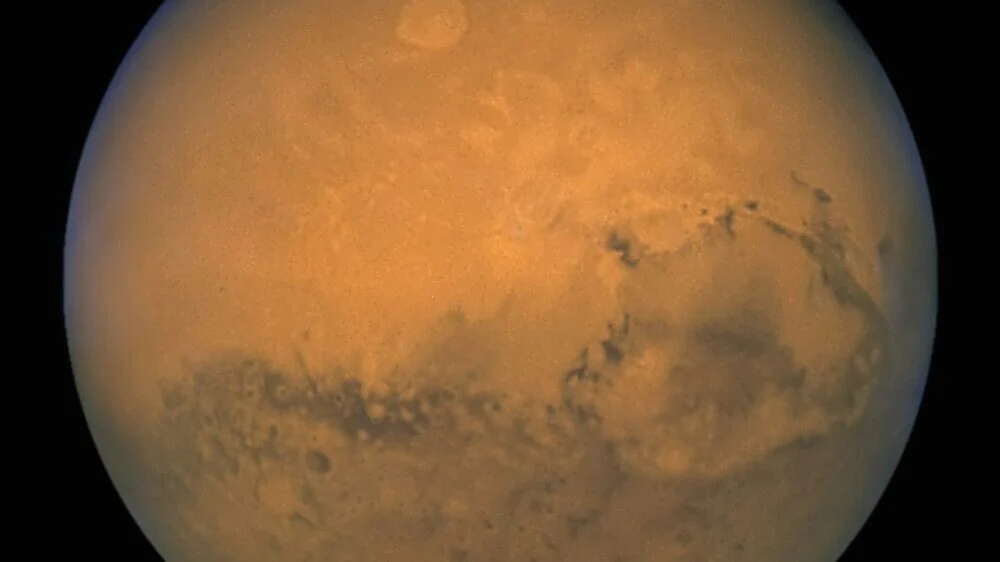

US National Aeronautics and Space Administration (NASA) announced the completion of the MAVEN (Mars Atmosphere and Volatile Evolution) mission after 11 years of operation. The agency noted that the station, with which communication was previously lost, is no longer capable of relaying data from Mars orbit and performing tasks as part of scientific research.
NASA's statement notes that as recently as December last year, all on-board systems of the station were operating normally. However, after the device left the far side of Mars, NASA's deep space communications network was unable to restore contact with it. Subsequent analysis of the telemetry showed that the probe had entered emergency mode and was rotating at an abnormally high speed.
In February, NASA formed a special commission to investigate the incident. Based on the results of the work, experts came to the conclusion that it was impossible to restore the device – due to uncontrolled rotation, the MAVEN batteries were completely discharged, which led to a shutdown of the communication system. As a result, the station lost the ability to perform any operations.
The reasons for the incident remain unknown. The commission's final report will be published later this year. Meanwhile, NASA began the formal process of winding down the mission, including archiving the entire array of data collected.
Atmospheric exploration and 3I/ATLAS surveys
MAVEN was launched in November 2013 to study the upper atmosphere of Mars. Thanks to the mission, scientists confirmed that solar storms significantly accelerate the destruction of the Martian atmosphere. In addition, the device detected several types of auroras that arise when high-energy particles interact with the planet’s atmospheric gases.
MAVEN also contributed to the observation of Comet 3I/ATLAS. For ten days, the device carried out special observations in various wavelength ranges, and then obtained high-resolution ultraviolet images that made it possible to detect hydrogen emitted by the comet.
“The MAVEN mission has truly taken our understanding of the Martian atmosphere and its evolution to the next level. This data set has had a huge impact on the entire field of research. Our science team is extremely proud of all of these outstanding discoveries,” said Shannon Curry, Chief Scientist of the MAVEN mission.
During the mission's existence, the MAVEN science team produced more than 800 scientific publications, NASA said in a statement. These results, among other things, are important for understanding what radiation protection measures should be developed before sending people to Mars.