


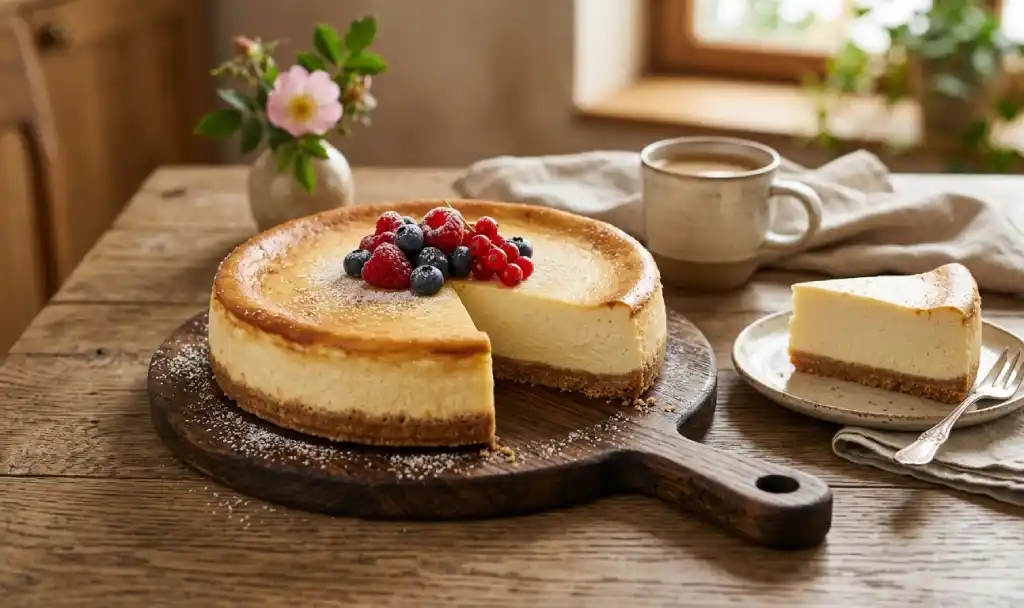

The world of confectionery art knows many masterpieces, but there are desserts that have long outgrown the boundaries of ordinary sweets, transforming into true gastronomic icons. They dictate fashion in cozy cafes from New York to Tokyo, become the main characters of culinary blogs, and make people forget about any diets. The legendary cheesecake has become a sacred symbol of such delicate sweet perfection, combining the simplicity of a crunchy base and the incredible refinement of a soft, cloud-like filling. This is not just a confectionery product, but a real philosophy of taste, where each piece melts in the mouth, leaving behind a long and pleasant creamy aftertaste. How did a regular pie become the favorite treat of millions, and what secrets does its centuries-old culinary history hide?
From Ancient Greece to American Cafes: The Evolution of a Masterpiece
Contrary to popular belief, the birthplace of this treat is not America at all, although it was there that it received its modern global recognition and cult status. The first historical mentions of a similar dish take us back to antiquity, to European lands where confectioners experimented with simple and nutritious ingredients. Over many centuries, the recipe transformed, absorbing the characteristics of the cuisines of different nations, and went through the following key stages of development:
- Treating athletes in Ancient Greece during the first Olympic Games to maintain physical strength and energy.
- Roman feasts, where a modified pie called “libum” was brought as an offering to the gods in grand temples.
- English medieval cookbooks, which first recorded recipes involving soaking cheese in milk and adding eggs.
- A technological breakthrough in 1872 in the USA, when an American farmer named William Lawrence accidentally invented delicate cream cheese.
- The appearance of the classic “New York” recipe in the first half of the 20th century thanks to restaurateur Arnold Reuben.
It was the appearance of rich, creamy cream cheese that forever changed the texture of the dessert, making it monolithic, smooth, and silky. American culinary experts abandoned traditional cottage cheese with grains in favor of the new product, which allowed them to create the very benchmark taste that we know today. Since then, the pie officially moved from the category of home baking to the menus of elite restaurants, becoming a hallmark of American culinary culture and opening a new era in the confectionery business.
Global Kaleidoscope: Varieties and Geography of the Cheese Treat
The modern confectionery world is incredibly flexible, so today, completely different sweets in terms of texture, philosophy, and method of preparation hide under the same name. Each country tries to add its own authentic element to the classic formula, changing the density, fat content, or baking technology. Depending on the culinary traditions of the region, these desserts can be divided into several of the most popular types:
- Classic baked (American type) — a dense, rich pie based on Philadelphia cheese with sour cream or heavy cream.
- Cold preparation (English type) — a light texture that solidifies in the refrigerator due to the addition of gelatin or mousse.
- Japanese cotton (souffle) — an incredibly fluffy, airy dessert that literally jiggles from a touch and melts in the mouth.
- San Sebastian (Basque burnt) — a pie without a pastry base with a caramelized, almost black crust and a delicate, slightly runny center.
- Lviv syrnyk — a traditional Ukrainian alternative made from rich homemade cottage cheese with raisins, covered in a thick layer of chocolate glaze.
Such a diversity of approaches proves that the main ingredient — cheese — is an ideal canvas for a confectioner’s creativity. Some prefer the heavy, rich texture of the Basque version, which resembles an exquisite custard, while others choose the weightlessness of the Japanese souffle, where a minimal amount of sugar allows one to enjoy the pure milky shade. Regardless of geography, the concept remains unchanged: harmony between the soft filling and additional flavor accents.
Secrets of Perfect Baking: How to Achieve Confectionery Perfection
Preparing the perfect baked dessert at home often seems like a real challenge for novice cooks, because this finicky dish does not forgive haste or carelessness. The filling can easily crack from temperature drops, become too dry, or conversely — fail to bake in the center. To avoid disappointments and create a true culinary masterpiece, experienced confectioners advise strictly adhering to several golden rules of the technological process:
- Using ingredients strictly at room temperature to obtain an absolutely homogeneous mass without lumps.
- Mixing the filling at the lowest speed of the mixer or with a spatula so as to not saturate the mixture with excess air.
- Mandatory baking in a water bath, which ensures uniform and gentle heating without burning the edges.
- Slow cooling: first in the turned-off oven with the door ajar, and only then — in the refrigerator.
The process of stabilization in the cold is perhaps the most important stage, lasting at least six hours. It is during this time that the structure fully forms, the creamy fats solidify, and the taste becomes balanced and deep. The cook’s patience is rewarded with a perfect, even cut of a piece that does not crumble and holds its shape. By adding fresh berries, salted caramel, or mango sauce on top, you can create new flavor variations every time, turning an ordinary home tea party into an exquisite celebration of haute cuisine.