

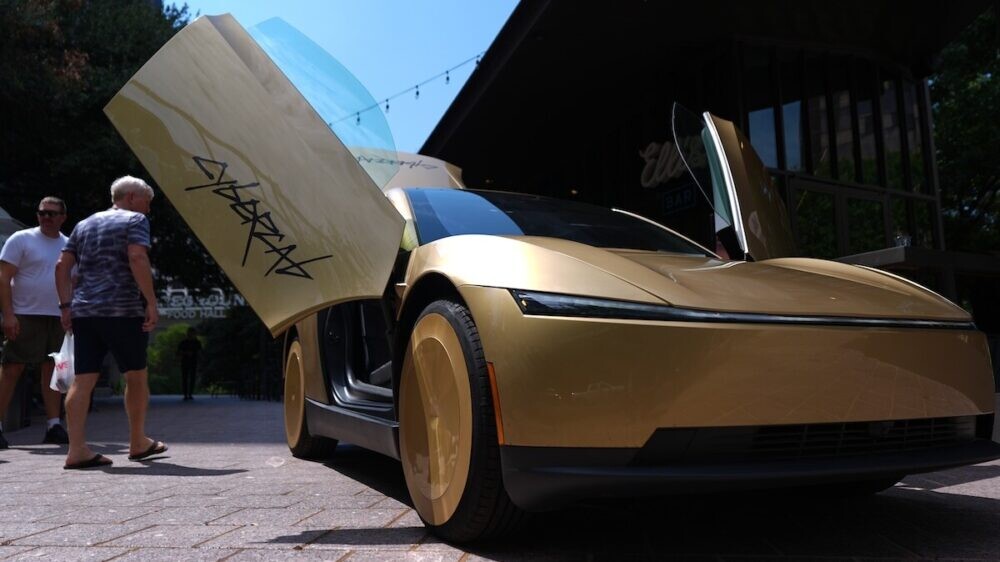

The National Highway Traffic Safety Administration (NHTSA) has begun reviewing Tesla's certification of its unmanned Cybercab robotaxi. The company recently showed the first samples of a new car without a steering wheel and pedals, which it is testing in Austin (Texas).
Tesla CEO Elon Musk presented the Cybercab prototype in 2024. The model, as the word “cab” in the name suggests, was developed specifically for Tesla’s Robotaxi driverless taxi program, which so far uses Model Y vehicles in six American cities. Musk promised that by the end of 2026, millions of Tesla robotaxis will be operating in the United States, but so far there are only a few hundred of them.
During a private event on September 3, influencers were given rides in gold Cybercabs equipped with gullwing doors and a touch screen instead of a steering wheel. Sales of two-seater electric vehicles costing about $30,000 have not yet begun, but they are already being implemented in the Tesla Robotaxi system. According to the company, at least 45 units were produced.
Tesla notified NHTSA at the event that it has certified the Cybercab as meeting federal safety standards and plans to expand testing of these electric vehicles. Authorities said they would look into the report.
“The cars lack conventional manual controls such as the brake pedal, gas pedal, steering wheel and rear view mirrors. NHTSA will examine the process and technical data Tesla relied on to certify Cybercab and related issues,” the regulator said in a statement.
Engineering tests of the first production Cybercab have begun in Austin pic.twitter.com/fk3KQvcE8a
— Tesla (@Tesla) June 30, 2026
Tesla is positioning the Cybercab as a safe, autonomous vehicle that is accessible to people with disabilities. In the road tracking system, the company’s engineers abandoned the use of lidars and radars in favor of eight cameras, the data from which is processed by a neural network.
Cybercab has started production pic.twitter.com/MAeswanf96
— Elon Musk (@elonmusk) April 24, 2026
In 2025, a US court ordered compensation of over $200 million in a claim for an accident with a Tesla Model S equipped with an autopilot. The jury found Musk's automaker one-third to blame for the incident, which killed one person and injured another.