


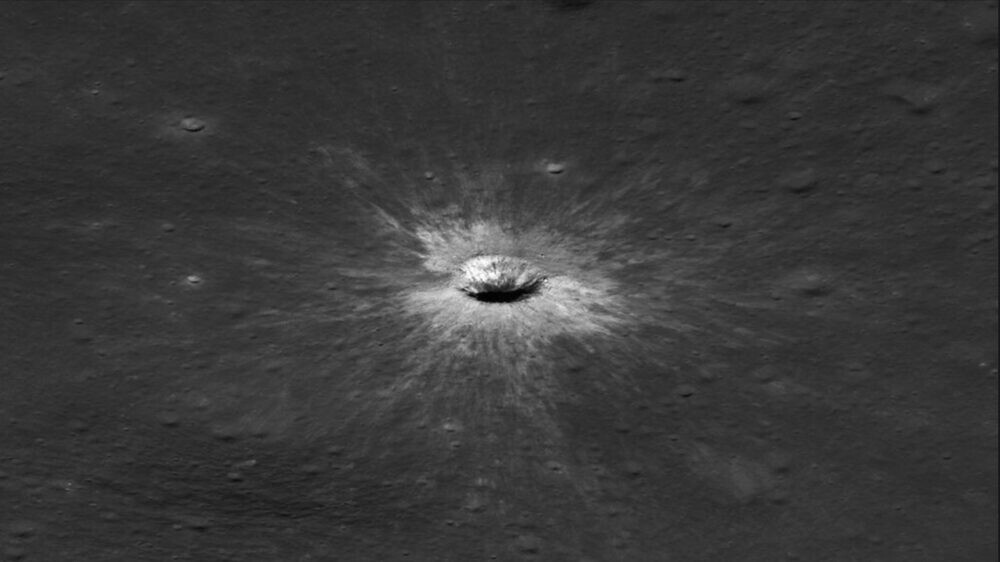

Researcher Robert Wagner, working with data from NASA's Lunar Reconnaissance Orbiter (LRO), has discovered a new crater on the Moon with a diameter approximately two football fields. It was formed as a result of a powerful collision about two years ago, but remained unnoticed for a long time. The crater was named after the late Thomas McGutchin, former director of the Lunar and Planetary Institute in Houston, Texas, NASA said.
The crater is located on the visible side of the Moon. The LRO apparatus first photographed it in May 2024, shortly after a collision with a fragment of an asteroid or comet. The moment of impact itself was not recorded in real time by either ground or space telescopes. Researchers estimate that the space object that left the crater could have been about the size of a three- to six-story building.
Images of the area taken by LRO's wide-angle camera had long gone unnoticed among the vast array of data. In 2025, Wagner, looking at a map of the Moon, noticed an unusually large bright spot surrounded by a dark halo. By comparing images obtained before and after the collision, the researcher determined that a new large crater had appeared on the surface.
“I just stopped, dropped everything and started to figure out what this spot was,” NASA quotes the researcher.
In the fall of 2025, LRO acquired more detailed images of the area, and in early 2026 the discovery was finally confirmed using a series of images taken by the Lunar Reconnaissance Orbiter Camera (LROC) Narrow Angle Camera (NAC).
The steep-sided crater measures about 728 feet (222 m) in diameter and 141 feet (43 m) deep. NBC News compares its size to Rome's Colosseum. According to the researchers, this is the largest impact crater discovered in the Solar System in the modern era of observations. Scientists note that collisions of this magnitude occur on the Moon approximately once every 132 years.
The Moon's got a big new crater! 🕳️
Spotted by NASA's Lunar Reconnaissance Orbiter, the McGetchin crater formed when a rock as big as a six-story building crashed into the Moon. It's 141 feet deep and wider than the length of two football fields.🪨💥🌕https://t.co/I2fX7bPts1 pic.twitter.com/Zft4mKUv1Z
— NASA Solar System (@NASASolarSystem) September 16, 2026
Analysis of the data showed that the soil ejected by the impact was scattered over 66 miles (over 100 km). In addition, around the crater, scientists discovered a so-called “cold zone” with a diameter of about four miles (about six km). It indicates that as a result of the impact, the upper layer of lunar regolith in this area became looser.