
An international team of scientists using the James Webb Space Telescope has for the first time studied an object that combines the properties of a black hole and a star. This category of bodies, known as “black hole stars,” previously existed only in theoretical models. The study was published in the journal Nature.
The object, called MoM-BH*-1, is comparable in size to a giant star: its envelope extends over a distance comparable to the size of the Solar System. At the same time, it emits about 100 billion times more energy than any known star, making it more similar to a black hole.
The object is located in the constellation Cetus, more than 10 billion light years from Earth and, according to scientists, was formed at an early stage in the development of the Universe – several hundred million years after the Big Bang.
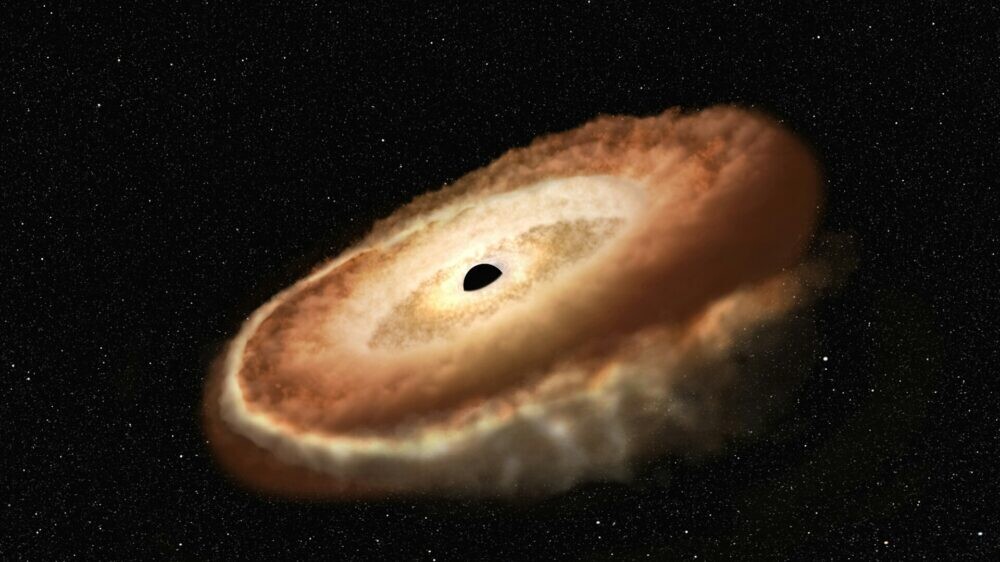
Scientists suggest that MoM-BH*-1 is an extremely dense cloud of gas, the energy source of which is not ordinary nuclear fusion, but a black hole located at the center.
“We believe that at the center there is a black hole with a mass of about 100,000 times the mass of the Sun. Around it is a huge shell of gas, reminiscent of the surface of a star the size of the solar system. This is truly a colossal object,” said study co-author Rohan Naidu in a press release from the Massachusetts Institute of Technology (MIT).
Initially, researchers used the James Webb Telescope to search for the most distant galaxies. When studying the resulting images, they noticed a source that stood out sharply from other objects – an extremely bright red dot.
Scientists initially assumed that the red color of the object was due to the cloud of dust surrounding it, but spectral data did not confirm this hypothesis. Scientists also noticed that the spectrum lacked signs of metals and other chemical elements, with the exception of hydrogen and helium.
“We started to wonder: could an object be so red if it was made entirely of hydrogen and there was no dust around it? To our surprise, it turned out that this is possible if the source is hidden behind an extremely dense layer of hydrogen – so dense that it resembles the surface of a giant star rather than a tenuous interstellar nebula,” said study co-author Robert Simcoe.
In addition, despite the unusual intensity of the light, at some wavelengths its emission almost completely disappeared. This phenomenon is called the Balmer jump. This feature is usually associated with dense gas in the atmospheres of stars several hundred million years old that absorbs photons. A similar feature, for example, is observed in Vega, one of the brightest stars in the night sky.
Scientists have suggested that a powerful source of energy is hidden inside the extremely dense hydrogen shell. This model explains both the Balmer jump, due to which part of the radiation is absorbed, and the almost complete absence of elements heavier than hydrogen and helium in the spectrum. Then the researchers considered an option in which the energy source was a black hole actively absorbing matter, and began to change its mass and other parameters, comparing the simulation results with observations.
If MoM-BH*-1 is indeed a “star with a black hole,” the discovery could help explain the nature of the so-called “little red dots” that appear in almost every James Webb deep space image.