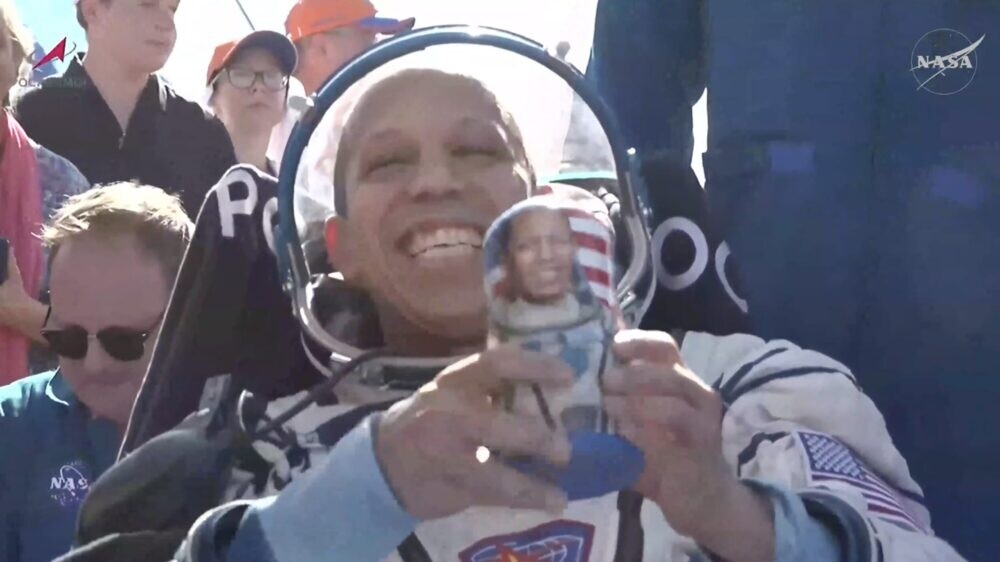

Having completed the 74th mission on the International Space Station (ISS), the crew of Roscosmos cosmonauts Sergei Kud-Sverchkov, Sergei Mikaev and NASA astronaut Chris Williams returned to Earth, the US space agency reports. The Soyuz MS-28 lander landed southeast of the city of Zhezkazgan in Kazakhstan.
The descent was carried out safely with the help of a parachute. As Williams landed, Roscosmos representatives traditionally presented him with a personalized matryoshka doll with his image. After a medical examination, the crew members flew by helicopter to Karaganda, where teams are usually stationed upon returning to Earth.
Williams then flew on a NASA plane to the Lyndon Johnson Space Center in Houston (Texas), and Kud-Sverchkov and Mikaev went to Star City, located in the Moscow region.
Welcome home! @Astro_ChrisW and his crewmates are back on solid Earth after their eight-month mission to low Earth orbit. pic.twitter.com/C8Ikkafb6f
— NASA (@NASA) July 26, 2026
The crew spent 241 days in space, made 3,856 orbits around the Earth and covered a distance of more than 165 million kilometers. This was the first mission for Williams and Mikaev, and the second for Kud-Sverchkov. The latter, before returning to Earth, handed over command of the Russian segment of the ISS to cosmonaut Pyotr Dubrov.
Participants of the 74th mission departed for the International Space Station on November 27, 2025 from the Kazakh Baikonur Cosmodrome. During the launch of the rocket, elements of the launch pad were damaged, but the launch went smoothly, and later the site was restored.
While aboard the orbiting laboratory, Williams participated in a wide range of scientific research into new cancer treatments and improving the production of materials used in high-performance computers and electronics in space. The astronaut also completed two spacewalks to prepare to upgrade the space station's power system and replace a faulty arm joint.
The work of the crew aboard the space station helps improve life on Earth and prepare for future manned missions to the Moon and Mars, NASA said. Roscosmos added that during the expedition, Mikaev and Kud-Sverchkov went into space twice, working on a program to implement 42 scientific experiments.
The astronauts took from outer space a special cassette with substrates on which a layer of gallium arsenide was formed under weightless conditions. This is part of the unique Ekran-M experiment to grow ultra-pure semiconductors, which in the future are planned to be produced directly in orbit for use in electronics, lasers and solar panels.
Mikaev and Kud-Sverchkov, as part of another experiment, installed a special apparatus for studying solar flares on the outside of the ISS during a five-hour spacewalk (Mikaev’s first in his career). The astronauts observed the nighttime ultraviolet glow of the Earth from inside the station to understand the influence of the Sun and thunderstorms on the Earth's upper atmosphere.
Both Russian cosmonauts also repaired an air leak at the station in early June. Then Chris Williams, along with members of the Crew-12 mission, had to hide inside the docked Crew Dragon, as RTVI previously reported.