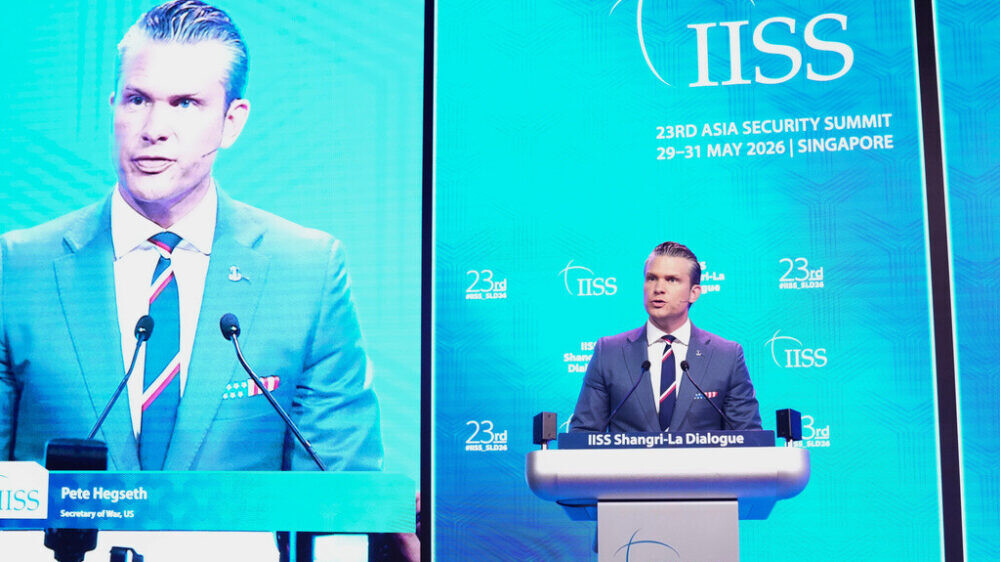

US Asian allies must invest more in their own defense, Pentagon chief Pete Hegseth said at the Shangri-La Dialogue security conference in Singapore over the weekend. According to him, security in the Pacific region has for too long been “disproportionately” dependent on US military power and Washington expects countries in the region to stop relying solely on American resources. Thus, he actually repeated the narratives with which the United States has been addressing its European allies in recent months, experts interviewed by RTVI.US confirmed.
Increased defense spending is a long-standing demand of the head of the White House, Donald Trump, to the Europeans, which he began to voice during his first presidential term. Last year, some NATO countries eventually agreed to increase spending to 5% of their GDP, citing a “long-term threat” from Russia as the reason.
The position voiced by the Pentagon towards its Asian allies is actually similar: if Asian countries want to count on US help, they must have their own combat-ready army, navy, and air force and integrate into a joint defense architecture. “The era of the United States subsidizing the defense of rich countries is over,” Hegseth said.
According to him, Washington will prioritize cooperation with “exemplary allies.” Such partners will be offered preferences: in particular, accelerated arms sales, in-depth industrial and intelligence cooperation.
“The position is: yes, America is a Pacific nation too, but we don’t need colonies, we need partners. It’s the same as with Europe,” political scientist Kirill Zadov commented to RTVI.US.
At the same time, Hegseth softened his rhetoric towards China: he did not declare a “communist threat” and never mentioned Taiwan during his speech in Singapore, notes the Wall Street Journal (WSJ). The Pentagon chief also spoke about the “more frequent meetings” that have recently taken place between representatives of the US and Chinese defense departments.
This, however, does not mean that China has ceased to be considered as a strategic competitor to the United States in the region, lawyer and political scientist Georgy Bardmesser told RTVI.US. The calmer rhetoric can only be explained by the recent meeting between Trump and Chinese President Xi Jinping, and the shift in the focus of American defense strategy to Asia began almost 20 years ago, under President Barack Obama.
At the same time, Beijing’s actions in recent years, on the contrary, have given an incentive to the US’s Asian allies (for example, Japan, Indonesia, the Philippines and Taiwan) to pay more attention to their own defense.
“It is clear that no one wants, especially in democratic countries, to sharply increase defense spending. We need such a consensus in society. China, through its behavior over the past few years, has created this consensus in all these countries. Indonesia has just signed a military cooperation agreement with America. If previously Indonesia was neutral in all global political conflicts, now it has taken a clearly visible step towards the American defense architecture. Japan buried its pacifist policy. Taiwan has sharply increased its spending. Because the American fleet, American marines, and American aviation cannot instantly appear next to Taiwan to defend it,” the expert gave examples.
Two mistakes of the West
At the beginning of the 21st century, Western countries and their allies in Asia believed that, firstly, the Chinese economic boom would make the PRC a more peace-loving country, and secondly, that every major power has a desire for stability. However, both of these hypotheses turned out to be wrong, Bardmesser concluded. For the last five years or so, China, on the contrary, has been conducting “wolf warrior diplomacy” and showing more aggression towards all its neighbors except Russia.
“Economic development has not made China peaceful at all. China is constantly trying to find points where it can come close to a conflict, but not start a conflict, but push through its interests. For example, these artificial islands in the South China Sea, all sorts of semi-provocations associated with Chinese coast guard boats, fishing vessels, which, perhaps, also catch fish, but their role is not to catch fish, but to push Chinese influence as far as possible,” noted the RTVI.US interlocutor.
Let us recall that last year the United States adopted a new national security strategy, which identifies China as its main strategic rival. The strategy's emphasis should be on a balanced trade relationship with Beijing coupled with military deterrence in the Indo-Pacific region. In total, China is mentioned 20 times in the document.
Taiwan's focus is on the status quo and the need to prevent any power from gaining control of the South China Sea, through which a third of global shipping traffic passes, making the region critically important. In this region, the United States is counting on the support of Japan and South Korea, which should increase defense spending, provide more access to ports and bases, and work with the United States to strengthen its presence in the Pacific.