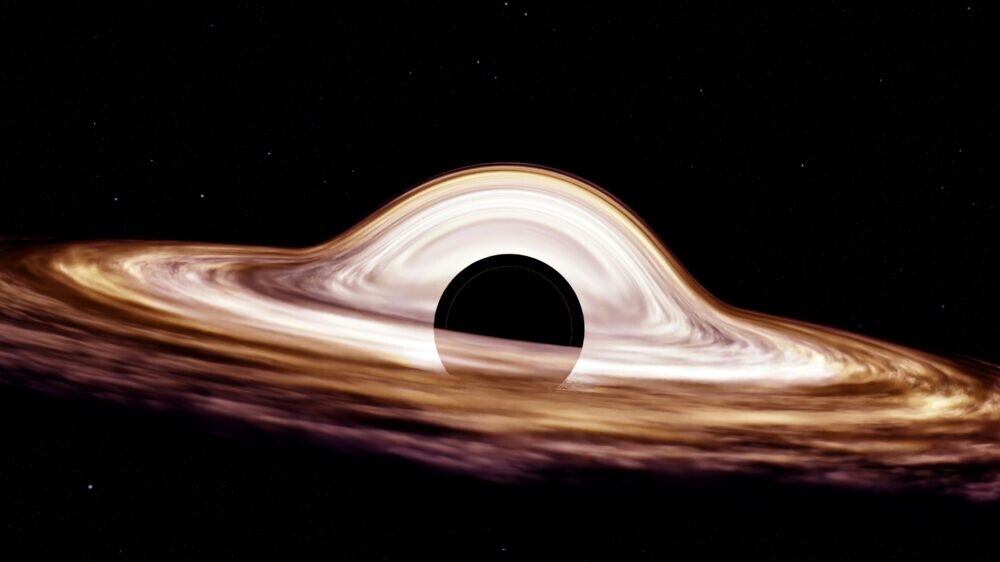

A group of European astronomers managed for the first time to discover the star S301, which, when moving along its elongated orbit, approaches the black hole Sagittarius A* at the center of the Milky Way to the minimum in the history of observations, 1.7 billion km. For comparison, the distance between the black hole and the Sun is more than 200 quadrillion kilometers.
Scientists believe that their study, published in the journal Nature, will subsequently make it possible to measure the rotation speed of a black hole, which was previously impossible to establish. Since S301 is so close to Sagittarius A*, the latter should influence its movement by its rotation.
For the observations, astronomers used the GRAVITY+ instrument as part of the Very Large Telescope in Chile. With its help, scientists were able to spot S301 among many other stars, despite its dim light, and also trace its trajectory. It completes a full revolution around a black hole in 8.7 years.
Astronomers noted that at the moment of its closest approach, S301 accelerates to 25,000 km/s—more than 8% of the speed of light. Researchers now want to capture the effect of space-time drag, or the so-called Lense-Thirring effect. In this phenomenon, a rotating black hole literally “spins” space around itself, and this should slightly change the orbit of the star.
Accurate data on the rotation of a black hole should subsequently help to understand how galactic centers are structured, how supermassive cosmic objects form and evolve, and how they affect the surrounding gas, stars, and the very structure of the Galaxy.
According to astrophysicist Laura Brenneman of the Harvard-Smithsonian Center for Astrophysics in Cambridge, Massachusetts, who was not involved in the study, the rapid rotation indicates that the black hole is regularly consuming matter. The slower rotation suggests the black hole is feeding more chaotically, she told Science News.
S301's next closest approach to Sagittarius A* is expected in 2031, when scientists expect to obtain the most important measurements that could change our understanding of the nature of black holes.
Earlier, another international group of scientists using the James Webb Space Telescope for the first time studied an object that combines the properties of a black hole and a star.