

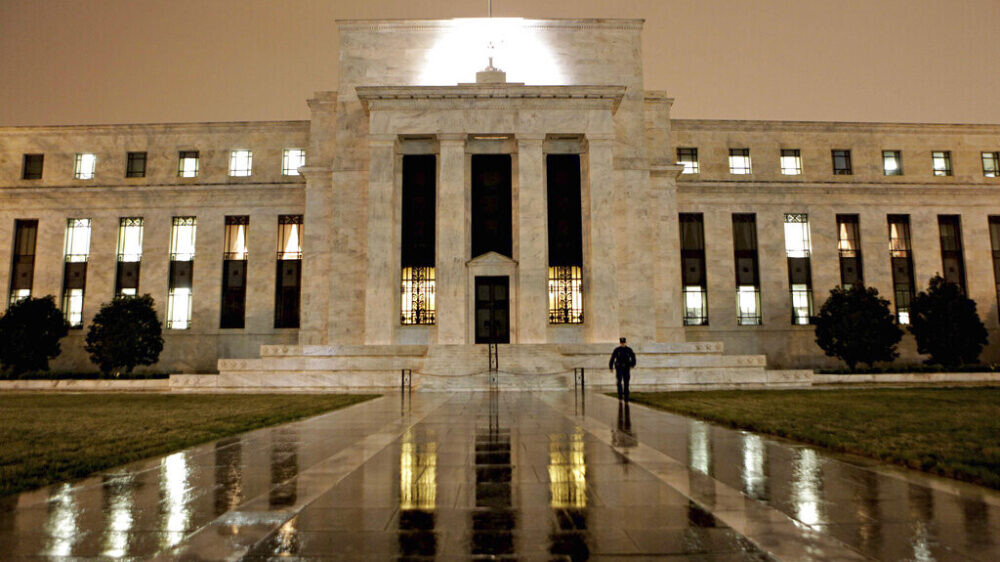

The US Federal Reserve System (FRS) raised its key rate by 0.25% to 3.75-4.0%. This is the first increase in the figure in more than three years. The decision was made unanimously. US President Donald Trump has repeatedly spoken out, on the contrary, in favor of lowering the rate.
The regulator explained its decision by high inflation rates and the desire to achieve their target of 2%. At the same time, the Fed acknowledged that uncertainty in the markets is also due to geopolitical events, without specifying what they were talking about. At the same time, it announces a steady pace of economic activity, strong growth in labor productivity and “significant” capital investment.
“Job growth has kept pace with the growth of the labor force, and the unemployment rate has remained virtually unchanged,” the regulator said in a statement.
The last time the Fed raised its key rate was in July 2023, when it was set at 5.25-5.5%. In 2024, the rate began to be lowered: in September – by 50 bp. p., up to 4.75-5%, in November – by 25 bp. p., up to 4.5-4.75%, and in December – up to 4.25-4.5%.
At the beginning of 2025, Donald Trump returned to the White House, who repeatedly called for a reduction in the key rate and criticized Jerome Powell, who headed the Fed from the first Republican presidential term, for his reluctance to take such a step. The regulator first took a pause, but in the second half of 2025 the rate was reduced three more times: in September – to 4-4.25%, in October – to 3.75-4%, in December – to 3.5-3.75%.
Powell’s term expired this spring, but he remained a member of the Fed’s board of governors, although he stated that he would work “invisibly.” The chairman of the regulator was Kevin Warsh, who was proposed by Trump himself, calling him the “standard candidate.” Warsh was confirmed by the Senate in May.
At the first two Fed meetings under Warsh’s leadership, the regulator did not change the key rate in any way. Already in May, as RTVI reported, more and more analysts spoke out in favor of the fact that Warsh could, on the contrary, even raise the figure.
The US Treasury Department previously signaled its desire to lower the rate by doubling the maximum volume of repurchase of long-term government bonds. Mikhail Melnik, a professor of economics at Kennesaw University in Georgia, told RTVI about this in detail.