

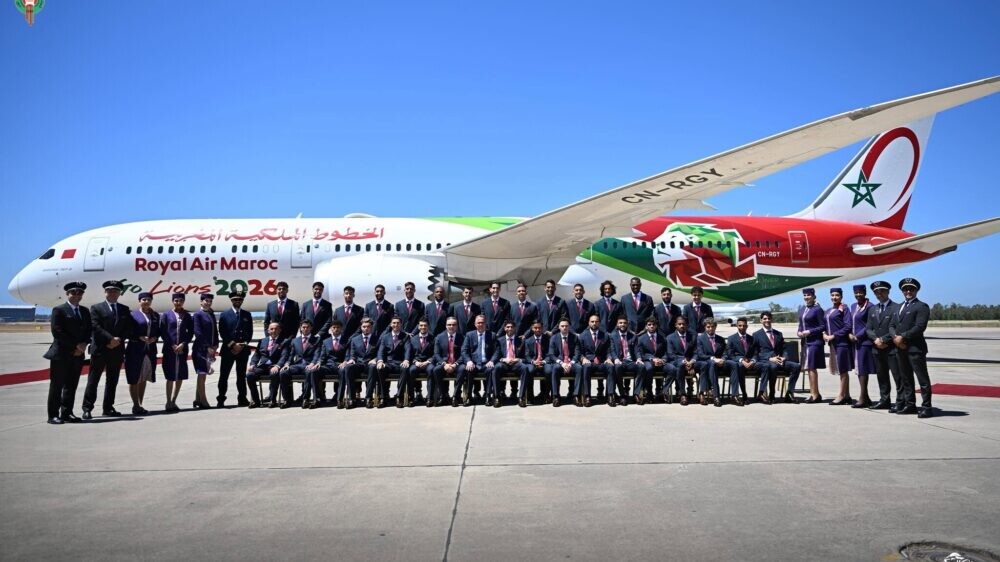

The Moroccan national football team approached the 2026 World Cup no longer in the status of a sensation, but as one of the most talked about teams on the planet. As The New Yorker notes, after their historic performance at the World Cup in Qatar four years ago, the Moroccan national team, known as the “Lions of Atlas,” has become a symbol of what is now called the Global South.
When the team sensationally reached the semifinals in Qatar, it was supported by millions of people far beyond Morocco, the publication writes. Fans filled cafes in Saudi Arabia, thousands watched matches in squares in Palestine, cars with Moroccan flags drove through the streets of Beirut, and the Nigerian president said the team had made the entire African continent proud
Qatar’s Al Jazeera wrote that the team gave the Global South “the strength to believe.”
The term “Global South” refers to states in Africa, Latin America, the Middle East and large parts of Asia that have historically been outside Western centers of power and have long experienced the effects of colonialism. Morocco, writes The New Yorker, turned out to be a particularly suitable symbol of this macro-region – the country is at once African, Arab and Muslim, and also has close ties to Europe. However, the publication notes, the question of who exactly Morocco represents turned out to be much more complicated than it might seem at first glance.
“Morocco defies easy classification. It is complex and multi-layered,” Safwan Masri, dean of Georgetown University in Qatar, told the New Yorker.
The players themselves try to emphasize all the components. After the victories, the players took to the field with Palestinian flags, expressing solidarity with the Arab world, and also carried the Amazigh flag, a symbol of the indigenous population of North Africa. According to various estimates, more than half of the inhabitants of Morocco have Amazigh roots.
Head coach Walid Regragui said after the victory over Portugal in 2022 that Morocco wants to represent all of Africa.
No longer outsiders
As of the summer of 2026, the national team ranks seventh in the FIFA rankings – the best result in its history. The team includes players from leading European clubs, including PSG, Real Madrid and Manchester United.
In addition, Morocco’s youth team won the Under-20 World Cup last year.
“We are no longer outsiders. People say 2022 was a miracle, but now it is the beginning of a new football power. Expectations have completely changed,” Moroccan sports journalist Saad Moufakkir told the New Yorker.
Before the Qatar tournament, only two teams outside Europe and South America had reached the semi-finals of the World Championships – the USA in 1930 and South Korea in 2002. Morocco became the third such team in the almost hundred-year history of the tournament.
This success was a source of pride not only within the country, but also for many fans in Africa and the Arab world. The then head coach of the Moroccan national team, Walid Regragui, compared the support for his team to the audience’s reaction to the film “Rocky” – the story of an underdog who challenges the established favorites.
The team entered the 2026 World Cup as one of the favorites in the second tier of world football. In Group C, the Moroccans will play Brazil, Scotland and Haiti.
Diaspora Team
Another feature of current Morocco is its international composition. As the New Yorker notes, 19 of the 26 players on the current roster were born outside the country. Many grew up in Spain, France, Belgium and the Netherlands, where they received their football education.
Among them are team captain Achraf Hakimi, who was born in Spain and came through the Real Madrid academy, midfielder Brahim Diaz, who played for the Spanish national team, as well as rising star Neil El-Ainaoui, who grew up in France and plays in Italy.
According to Mufakkir, the players of the national team speak six languages at once, and English is often the main language of communication within the team.