


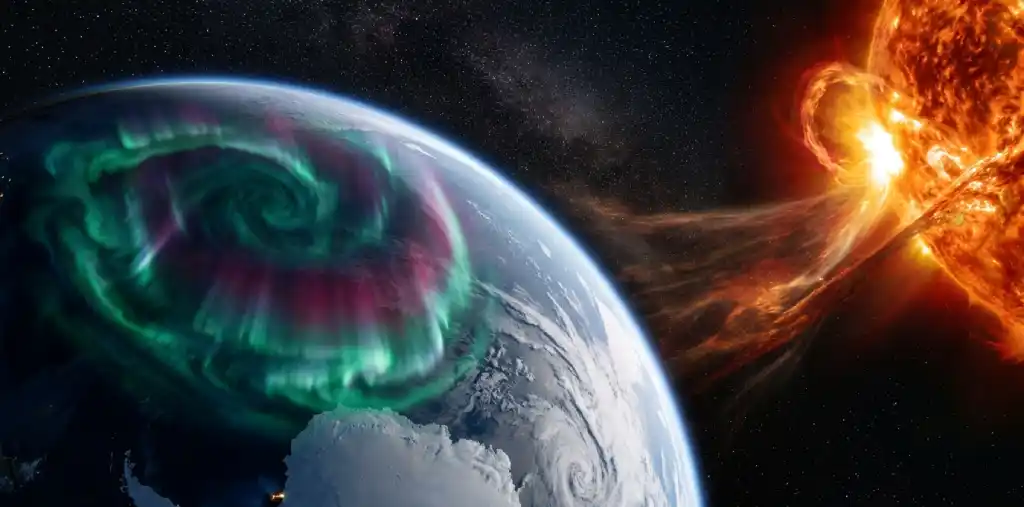

The Universe is never in a state of absolute rest, and our native Sun is not just a gentle source of light, but a giant, turbulent thermonuclear reactor. From time to time, colossal flares occur on its surface, releasing an incredible amount of energy and charged particles. When this solar wind reaches our planet at tremendous speed, what scientists call a geomagnetic disturbance occurs, and a regular magnetic storm becomes the main topic of news and discussions. This invisible cosmic storm does not simply paint the sky in the fantastic colors of the aurora borealis, but directly interferes with the operation of our technologies, alters the well-being of millions of people, and forces the planet to literally shudder under powerful electromagnetic pressure.
Cosmic Mechanics: How a Geomagnetic Storm Is Born
To understand the nature of this phenomenon, it is worth imagining the Earth as a giant magnet surrounded by a protective shield—the magnetosphere. It is this shield that takes the blows from deep space, protecting all living things from destructive radiation. The process of the emergence and development of a magnetic storm consists of several sequential and interconnected stages:
- The occurrence of a solar flare or a coronal mass ejection on the surface of the luminary.
- The formation of a powerful stream of high-energy plasma moving through the system.
- The collision of the solar wind with the natural magnetic field of our planet.
- The deformation and compression of the Earth’s protective shield under the influence of cosmic particles.
- The emergence of chaotic fluctuations and induction currents in the upper layers of the atmosphere.
When the planet’s protective shield begins to vibrate under the pressure of solar plasma, a chain reaction is triggered that affects the entire geosphere. These fluctuations are recorded by special ground stations all over the world and are classified according to a special scale of indices. Despite the fact that the human eye is unable to see these magnetic perturbations in real time, their effects prove to be global: from spectacular nightly glows in geographical latitudes atypical for this to sudden failures in the operation of high-precision navigation equipment.
Technological Collapse: What the Sun’s Excitement Threatens for Civilization
Modern humanity has become critically dependent on electronics, satellites, and global data transmission networks. It is this vulnerability that makes us ideal targets for space weather, as a powerful geomagnetic surge is capable of paralyzing key life-support systems. During severe storms, the greatest blow is usually dealt to the following areas:
- Satellite navigation (GPS, GLONASS), where serious errors in geopositioning arise.
- Orbital spacecraft and telecommunications satellites due to the overheating of electronics.
- Ground-based power transmission lines (PTL), where dangerous excess currents are induced.
- Transatlantic cable communications and underwater internet transmission systems.
- Shortwave radio communication used by aviation and maritime transport.
History knows cases when solar activity left entire metropolises without light for long hours, as happened in the Canadian province of Quebec in the last century. Today, the risks have multiplied, because microcircuits have become thinner and more sensitive to any externally induced currents. Scientists continuously monitor sunspots to have time to warn energy companies and air carriers about the need to adjust routes or temporarily switch transformers into a safe operating mode.
Biological Resonance: How Space Dictates Rules to Our Body
The impact of magnetic storms on human health has long caused debate among scientists, but today more and more studies confirm the connection between space and biology. Our body is a complex electrochemical mechanism that reacts sensitively to changes in external fields. Most often, weather-sensitive people experience the following unpleasant symptoms during active flares on the Sun:
- Sudden attacks of severe headache, migraines, and a feeling of heaviness in the head.
- Sharp fluctuations in blood pressure in both hypertensive and hypotensive individuals.
- Insomnia, increased anxiety, irritability, or, conversely, chronic fatigue.
- Exacerbation of chronic diseases of the cardiovascular system and joints.
- Slowed reaction times and decreased concentration during daily work.
Particularly vulnerable on these days are the elderly and those with heart problems, as fluctuations in the magnetic field can change blood viscosity and slow down capillary blood flow. The media and doctors advise avoiding stress, reducing physical exertion, balancing nutrition, and giving up stimulants like coffee or alcohol during periods of solar disturbances. Cosmic storms are a natural part of the evolution of our stellar system, and humanity can only adapt by keeping a space weather forecast close at hand.