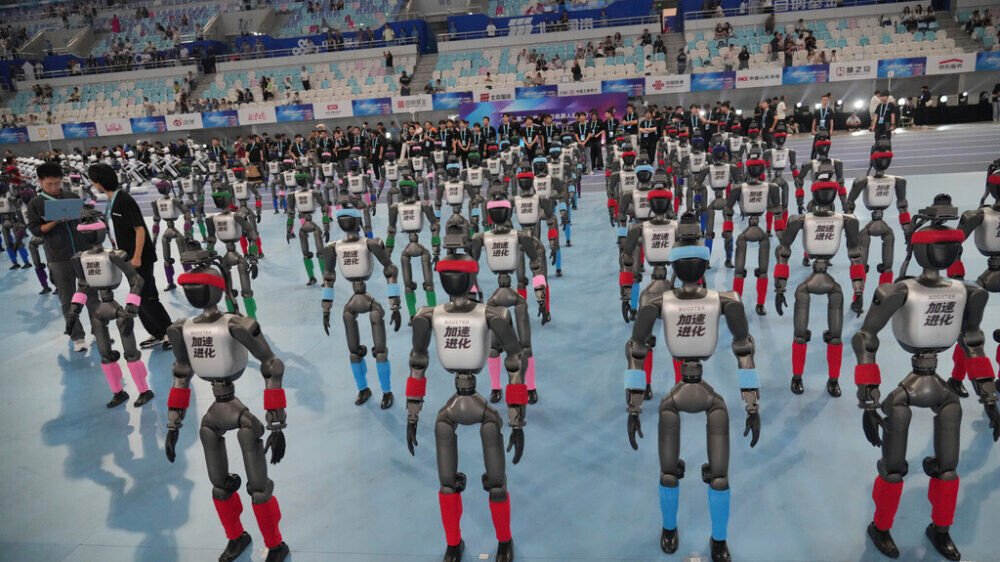

Chinese humanoid robots set new records, beating human performance in the 100-meter sprint and standing high jump at the World Humanoid Robot Games in Beijing, reports the Associated Press (AP).
Both robots were created by X-Humanoid from Beijing. The first of them surpassed Jamaican athlete Usain Bolt in the 100 m race. The athlete ran this distance in a record 9.58 seconds for humans during competitions in Berlin in 2009. The humanoid robot was able to cover the path in 9.39 seconds.
WATCH: Chinese robot beats Usain Bolt's 100m world record on the opening day of the Olympics-like World Humanoid Robot Games in Beijing. Read more here: https://t.co/aHbmKfOG3h pic.twitter.com/Ft0GZWbyBs
— The Associated Press (@AP) August 23, 2026
Another humanoid surpassed the figure of Cuban Javier Sotomayor, recorded back in 1993. The Cuban then jumped 2.45 m from a running start, and the robot jumped 2.88 m from a standing start. By the way, the participants in last year’s Robot Olympics jumped almost three times worse.
The current records, apparently, are not the limit of the capabilities of today's humanoids. As AP notes, on the eve of the competition in a test run, the robot from Honor ran a hundred meters in 9.32 seconds.
🚨A humanoid robot just beats human at the high jump
TienKung cleared 2.8843 meters in the standing high jump — surpassing the 2.45-meter best mark recorded by human men#WorldHumanoidRobotGames https://t.co/RnmdYzb5s6 pic.twitter.com/b3Eosd3UGs
— 智东西China AI News (@Chinazhidx) August 22, 2026
The event takes place over five days from August 22 to 26 at the National Speed Skating Stadium, built in Beijing for the 2022 Winter Olympics. A total of 2,056 robots are participating, belonging to 666 teams from 16 countries, including the USA, Japan, Germany and Brazil.
The games include 51 disciplines and more than 1,000 competitions – including running, table tennis, football, weightlifting and tug of war.
Some viewers admitted that they were impressed by the rapidly growing capabilities of humanoid robots. Liu Tao, who watched the competition with his son, said he hoped to see “the best robots China has to offer.” Another attendee at the event, Yang Shangzheng, commented to the AP about his “delight” at the humanoids’ ability to perform athletic elements typical of humans.
Chinese robots previously raised concerns among US authorities. In July, the US Federal Communications Commission announced a ban on the import of new foreign-made humanoid robots, which was seen as aimed at China, since most models are made there.