



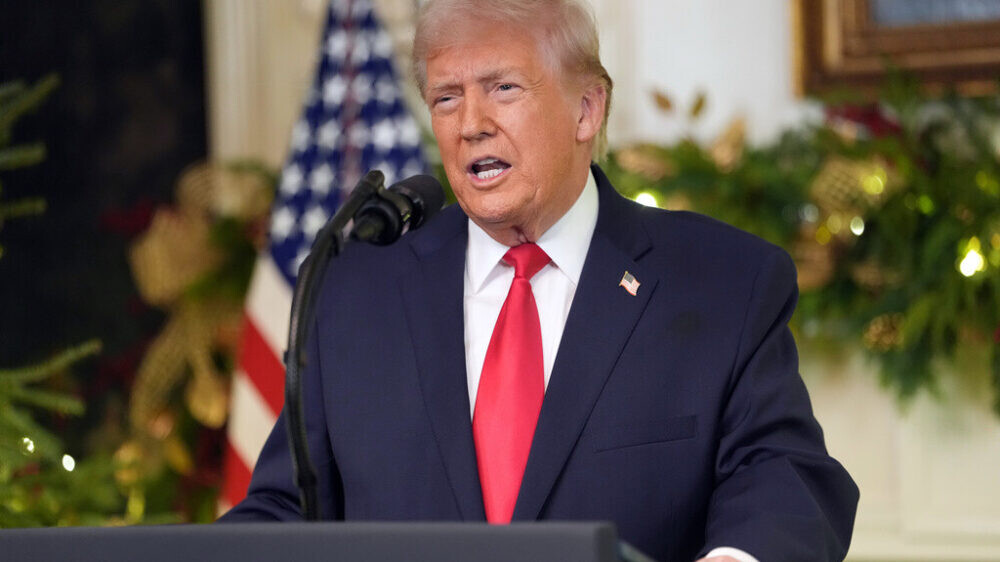

US President Donald Trump returned to the White House earlier than planned from his Camp David residence in Maryland amid a new escalation in the Middle East. Tehran said it had conveyed its terms for ending the war through Qatar, and the Iran-backed Houthis attempted to launch a missile attack on Riyadh. The State Department called on Americans in the region to be extra vigilant. Read about how the situation in the Middle East is developing and what scenarios Trump is considering regarding Iran in the RTVI material.
According to Fox News, the Marine One presidential helicopter arrived at the Ellipse in Washington, D.C., around 8:00 p.m. Trump's return was confirmed by White House-affiliated channel Rapid Response 47 on the social network X (formerly Twitter).
“Trump's return comes as his administration considers next steps in the war with Iran and ahead of his trip to New York for the UN General Assembly next week,” Fox News noted.
Around the same time, the Secretary of the Supreme National Security Council of Iran, Mohsen Rezaei, announced that the Islamic Republic had put forward seven conditions that the Iranian side offered to the American side for “the start of any negotiations.”
“Tehran’s message is clear and unambiguous: if Washington wants to get out of the predicament it has created and not get involved in it again, it has no choice but to accept Iran’s rights and conditions,” Rezaei said.
In an interview with Al Jazeera, the Iranian official named three of the conditions put forward to the White House – an end to the war on all fronts, especially in Lebanon, the unfreezing of Iranian foreign assets and an end to the naval blockade. According to Rezaei, accepting these conditions “meets Washington’s interests” and Iran is “ready for a decisive war,” so “Trump’s threats will not bring any results.” All conditions, as Rezaei noted, were conveyed through intermediaries in Qatar, and Tehran is waiting for a response from the American leader.
Trump admitted his readiness to meet with Iranian President Masoud Pezeshkian at the upcoming session of the UN General Assembly in New York, Fox News correspondent Trey Ingst reported. According to him, the head of the White House told him that he was in “decision-making mode” and “big things will happen in the near future.” Trump called Iranian leaders “hiding like rats.”
According to Ingst, Trump described to him three options that are being considered regarding Iran. The Islamic Republic could be “destroyed,” the US could “allow Iran to rot economically,” or a “deal would be struck.” The head of the White House stressed that Tehran “better behave well.”
However, on Saturday evening the US State Department issued a statement for American citizens in the Middle East. They warned of a possible escalation of the conflict in the region due to fighting by the Tehran-backed Houthis against Saudi Arabia.
“Iran and Iran-supporting groups may target U.S. interests abroad or locations associated with the United States and Americans around the world, including U.S. businesses and other institutions,” the State Department's Bureau of Consular Affairs said in a statement.
The security alert affected Bahrain, Egypt, Iraq, Israel, Jordan, Kuwait, Qatar, Lebanon, Oman, Syria, UAE, as well as Yemen and Saudi Arabia.
On Saturday, Riyadh said it had intercepted a ballistic missile that the Houthis attempted to attack the capital. According to the Associated Press (AP), some residents of Riyadh heard an explosion and later saw a plume of smoke near the airport. There were no reports of casualties or damage.
The city came under fire for the first time since the Houthis sharply intensified attacks on the kingdom in July 2026 – declaring a naval blockade of Saudi Arabia, attacking two Saudi oil tankers in the Red Sea and launching missile attacks on energy facilities in Jizan and Yanbu, which opened a new front in the war with Iran, the AP notes.
Shortly before that, the Houthis said they had struck targets in Saudi Arabia: “critical installations” in Riyadh and the facilities of the world’s largest oil producer Aramco in Yanbu, causing “massive fires.” There has been no independent confirmation of these claims. On September 10-11, the Houthis launched a surprise offensive in Yemen, capturing the port city of Mokha and the strategically important island of Perim in the Bab al-Mandeb Strait. As RTVI reported, before this, the Crown Prince of Saudi Arabia, Mohammed bin Salman, called Trump twice and asked him in vain to carry out airstrikes against the rebels.
In July, the kingdom carried out hundreds of airstrikes against Houthi-controlled areas of Yemen using F-15 and Typhoon fighter jets. They hit the provinces of Hajjah, Taiz, Marib, Al-Jawf and Saada, as well as the runways of Sanaa airport. The US provided intelligence and targeting support to Riyadh, including real-time targeting, but was not directly involved.
In a conversation with Ingst, Trump said that the White House is in contact with the Houthis in Yemen and they “agree not to fight with the United States.” Asked about warnings sent to American citizens in the Middle East, he called Sept. 19 and 20 “a weekend like any other.”