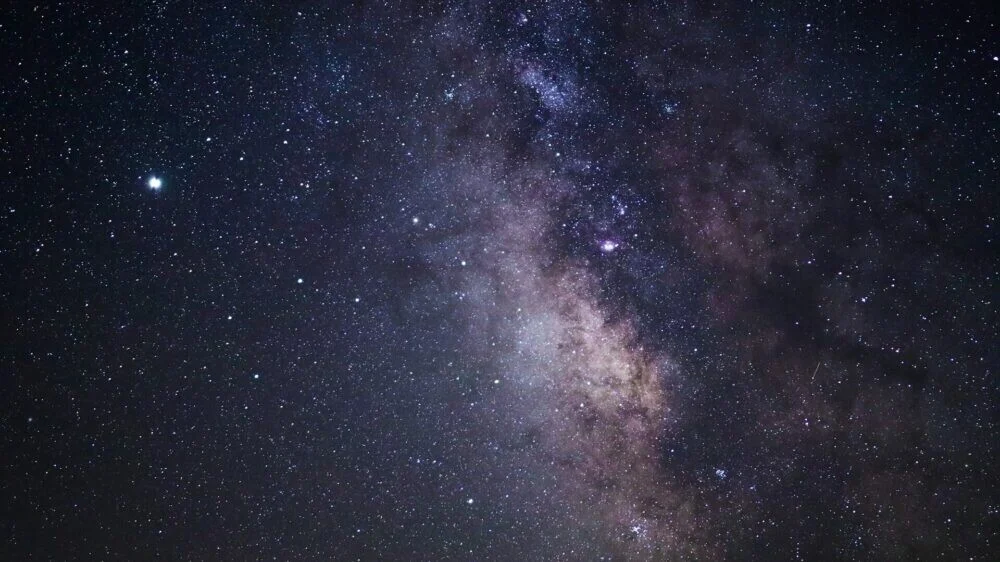

Black holes not only absorb matter, but are also capable of expelling some of the matter in the form of powerful streams called galactic winds. For more than half a century, scientists could not confirm the existence of such a wind at Sagittarius A*, a supermassive black hole in the center of the Milky Way galaxy, where the solar system and planet Earth are located. Astrophysicists from Northwestern University (Illinois) were able to solve this problem – they obtained an image of a cone-shaped cavity inside a cloud of cold molecular gas. This area near the black hole, in their opinion, is a trace of the influence of the wind. The results of the work were published in The Astrophysical Journal Letters.
When matter is attracted to a black hole, its speed increases, approaching the speed of light. Part of this matter is pushed outward under the influence of the resulting pressure. Similar phenomena have been repeatedly observed in active galactic nuclei, but until now it has not been possible to detect such emissions from Sagittarius A*. This is due to the fact that the black hole at the center of the Milky Way absorbs matter relatively slowly, and observations are complicated by dense layers of gas and dust.
“To observe our own black hole, we have to look through the disk of our galaxy. This means that between us and the object there are gas, dust and ionized structures, through which it is extremely difficult to see anything,” said study co-author Elena Murchikova.
For the analysis, scientists used data from the ALMA (Atacama Large Millimeter/submillimeter Array) radio telescope in Chile over five years. The resulting image showed the distribution of cold gas at a distance of about three light years from Sagittarius A*. After applying a special calibration that removed the black hole's own radio emission, the researchers discovered an elongated cone-shaped cavity about three light years long inside the cloud.
Scientists concluded that this structure could have been formed under the influence of hot matter from a black hole. Such a flow could either push the cold gas out of this zone, or heat it so much that it was no longer visible.
“If a black hole ejects hot material, it will not be able to coexist with the cold gas. It will either push this gas out or heat it up. And if the gas gets too hot, we simply stop seeing it,” said co-author Mark Gorski.
Although stars can also create winds, their energy is not enough to form such a large cavity.
“We calculated how much energy it took to create this cavity. The stars in this part of the galaxy are not capable of providing such a supply. Therefore, the source must be in a supermassive black hole. Moreover, the shape of the cone points directly at her,” Gorski noted.
To rule out the possibility of error, scientists compared the results with observations from the Chandra X-ray Observatory. X-ray images confirmed the presence of radiation in the same area where the cavity in the cold gas was discovered.
The data obtained shows: Sagittarius A* is in a “quiet state”. However, the detected wind cannot be called weak. According to researchers, it has existed for about 20 thousand years.
“Most galaxies are basically in a state where they are not very active. But we can usually observe them only when they go through the “fireworks” stage. It is very interesting to study black holes during such active periods, but this is not their dominant state. Sagittarius A* finally gives us the opportunity to see what a black hole looks like in a quiet state,” said Murchikova.