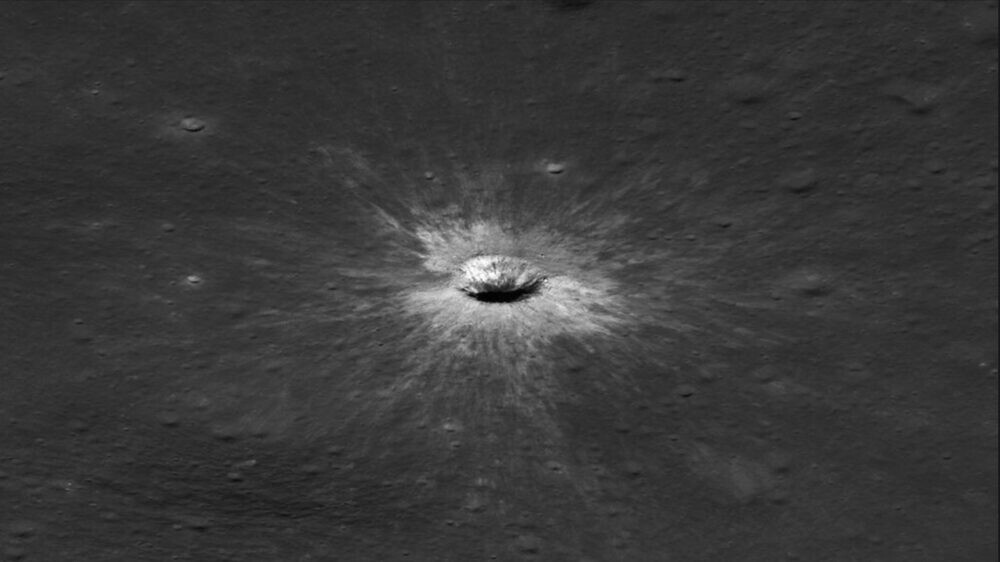

South Korea's Danuri lunar orbiter, also known as the Korean Pathfinder Lunar Orbiter (KPLO), captured images of the site where a SpaceX rocket's upper stage impacted the lunar surface. reported Korean Aerospace Administration. Cosmogeologist Kirby Runyon from the Planetary Science Institute in Arizona told RTVI about what new information about the Earth’s satellite this unique “field experiment” can provide.
The spent upper stage of the Falcon 9 rocket fell to the Moon on Wednesday at approximately 2:34 a.m. Eastern Time (ET) in the Einstein Crater region near the western edge of the lunar disk. The impact occurred on the visible side of the satellite, however, as RTVI said, it was not possible to record this moment using spacecraft.
Just before impact, the stage was traveling at about 5,400 mph (8,700 km/h). The impact is believed to have created a crater on the lunar surface nearly 90 feet (27 m) wide and about 16 feet (5 m) deep. Its exact dimensions are still unknown.
The fact that the collision actually occurred is evidenced by data from the European Southern Observatory telescope in Chile. After the impact, it recorded a stream of sodium and lithium that stretched for tens of kilometers and remained visible for at least 5-10 minutes.
The first images were obtained using the high-resolution Lunar Terrain Imager (LUTI) camera installed on the Danuri spacecraft. The probe took pictures of the area before and after the collision with the object.
In the photographs, the area after the impact looks like a small dark spot. Earlier images of the same area of the lunar surface near Einstein Crater do not show this trace.
2022년8월5일달로향했던대한민국달궤도선다누리,
2026년 8월 5일 스페이스X 팰컨9 발사체 상단부의 달 표면 충돌 전·후 포착!› #우주항공청 #KASA #다누리 pic.twitter.com/iZZ0OTn3yl
— 우주항공청 KASA (@with_KASA) August 6, 2026
The collision area should also be photographed by NASA's Lunar Reconnaissance Orbiter in lunar orbit. However, the agency expects that the first images will not be received until next week.
A number of experts believe that the collision could have been avoided if, after completing the main mission, the stage had been placed into a heliocentric orbit. However, according to Runyon, after completion of work, such objects are deliberately brought into a safe state through so-called passivation – the removal or consumption of remaining energy reserves. This process reduces the risk of fuel tanks or batteries exploding and resulting in hazardous space debris.
“After completing its task, the rocket stages are left without fuel and electricity, so this stage could no longer change the trajectory and avoid a collision. This passivation is a safety measure designed to prevent fuel tanks or batteries from exploding,” Runyon said.
According to Runyon, what happened should be considered a “successful field experiment.” New craters are constantly forming on the Moon, but in this case, scientists know in advance the key parameters of the colliding object – its mass, speed, as well as the time and place of impact. This allows the incident to be used for scientific purposes.
New craters are constantly forming on the Moon, but in this case, scientists know in advance the key parameters of the colliding object – its mass, speed, as well as the time and place of impact. This allows the incident to be used for scientific purposes.
In particular, researchers will be able to study in more detail the process of formation of new craters during a collision with a man-made object, the initial characteristics of which are known. The incident makes it possible to test how accurately experts are able to predict the time and place of the fall of artificial objects to the Moon.
In addition, the impact ejects material from deeper layers of lunar soil, usually inaccessible to direct observation, onto the surface. Studying it could provide additional information about the subsurface structure of the Moon, Runyon said.
The expert added that such an incident does not entail legal liability.
“As far as I understand, there is no legal liability for colliding with a natural object. In my opinion, this is how it should be. An exception could be the situation if any party had legally valid rights to the site that was hit,” he said.