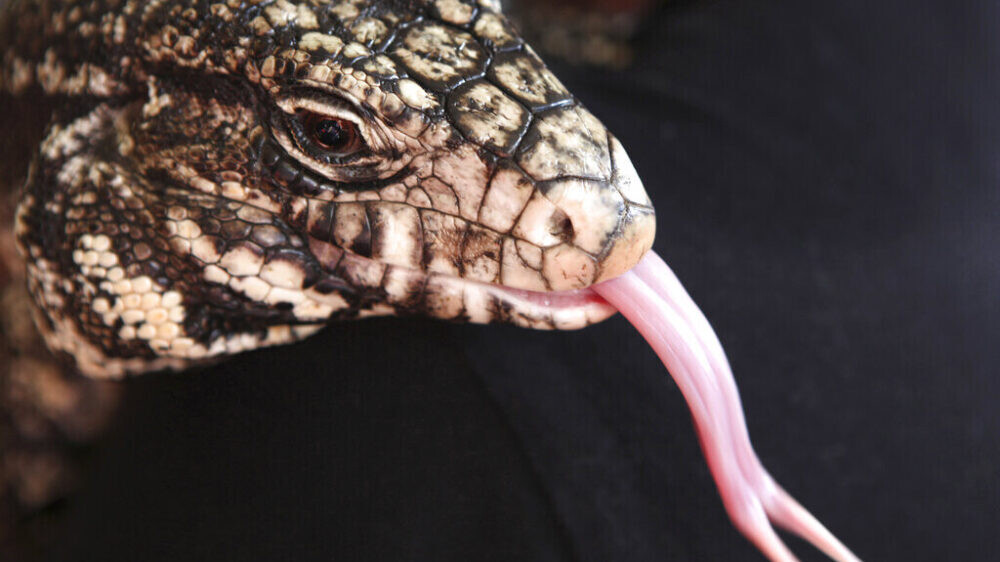

An invasive lizard species that can carry parasites and dangerous bacteria, including salmonella, is spreading in Georgia, CBS News reports. Their high reproductive rate allows these reptiles to rapidly increase in numbers and displace native species – they have already established a stable population in Tooms and Tattnall counties.
We are talking about the Argentine black and white tegu (Salvator merianae, giant tegu), which lives in South America. Adults are black or dark gray with white stripes on the back and tail. They reach lengths of up to 1.2 m (4 ft) and weigh over 4.5 kg (over 10 lb). The hatchlings are about 15–20 cm (6–8 in) long and have a bright green head coloration that fades about a month after birth.
Tegus are diurnal, highly mobile, swim well and are able to stay under water for a long time. The state Department of Natural Resources began investigating the first cases of these reptiles in Georgia back in 2018, but since then their population has grown significantly.
It is still unknown exactly how the animals ended up in the United States, but experts believe the trade in exotic pets is the most likely reason. The lizard's natural habitat covers Argentina, Uruguay, Paraguay and Brazil.
As of December 2023, Argentine black-and-white tegus are officially classified as wild animals in Georgia – the importation and breeding of lizards in the state is prohibited by law. Only those owners who registered and microchipped their animals before the new rules came into force can keep them as pets.
The department has been implementing a program to catch and euthanize them since 2022, but recently there have been at least 56 sightings of these reptiles in Georgia, the Savannah Morning News notes.
What is the risk of spread?
Argentine tegus pose a serious threat to native species. Tegus eat the eggs of ground-nesting birds, including quail and wild turkeys, as well as the eggs of other reptiles, such as American alligators and the rare gopher tortoise. Their diet is not limited to this – tegus also feed on fruits and vegetables, various plants, pet food, carrion and small animals.
There are also concerns that tegus may carry parasites and bacteria that can damage crops. The situation is aggravated by the lack of natural enemies of tegus in Georgia and their high fecundity. One female is capable of laying up to 35 eggs annually. The offspring usually appear in the summer – in June and July, so residents of the state may see these reptiles in the wild in the coming months.
Although Argentine black and white tegus are generally not aggressive and rarely pose a direct threat to humans, experts recommend avoiding direct contact. If you spot lizards, you should report it to the Georgia Department of Natural Resources and do not attempt to catch the animals yourself.
Residents in Toomes and Tattnall counties are advised not to leave pet food outside, fill in burrows and other potential hiding places, and remove brush piles and debris from areas that may provide shelter for tegus.
Experts warn that without effective control measures, this invasive species will continue to spread throughout the Southeast United States. In recent years, sightings of the Argentine black and white tegu have also been reported in Florida, Alabama, South Carolina and Texas.