
The US Treasury Department's decision to double the maximum amount of long-term government bond purchases changes virtually nothing from a financial point of view, but sends an important signal to the Federal Reserve System (Fed) about the need to ease monetary policy. This opinion was expressed in a conversation with RTVI by Mikhail Melnik, professor of economics at Kennesaw University in Georgia. According to him, signs of a national debt crisis have appeared in the United States, and the actions of the authorities in the future may lead to a new acceleration of inflation.
The Ministry of Finance announced its decision on Wednesday, explaining it as a desire to support liquidity. The current cap on long-term bond repurchases of $2 billion will be increased to a minimum of $4 billion on September 9. Around the same time, the US national debt exceeded $40 trillion. Last week, the Treasury also reported that the monthly deficit for July was $432.3 billion, the highest since March 2021.
The economy reacted ambiguously to the Finance Ministry's decision. For example, the stock market and bond prices fell, while gold and oil prices began to rise. On Thursday, however, bonds recovered their fall, especially after Treasury Secretary Scott Bessent made a statement in an interview with CNBC that he allowed for a further increase in bond repurchase volumes. Analysts compared the movement of Treasuries in the market to “rearranging the deck chairs on the Titanic.”
Mikhail Melnik, however, highlights precisely the “competent” reaction of gold.
“The Ministry of Finance has nothing to do with the monetary program, this is the fiscal side. But they announced it. What does this news really look like? What the Ministry of Finance did does not mean anything at all from a financial point of view. They said that they would increase the volume of purchases of government loans (bonds) from $2 billion to $4 billion. Well, fine, fine, that's beautiful, but we borrow $120 billion a month! That is, this is a relatively small amount in relation to the actual loan. However, this did have a real impact on gold. Question: Why does this affect gold and not the stock market? And why does this affect government loans so seriously? And the answer is very simple. By this action, the Ministry of Finance sends a signal to the Federal Reserve,” the expert explained.
According to Melnyk, a government debt crisis is brewing all over the world. In the US, a symptom was the rise in interest rates, especially on 30-year government loans. At the beginning of this week, their yield reached 3.5%.
“I haven’t seen such an indicator since approximately 2003,” Melnik said. — That is, roughly speaking, we have dropped back more than 20 years. But since then the economy has changed a lot. Accordingly, such rates should not exist. This most likely indicates the beginning of a crisis,” commented an RTVI interlocutor.
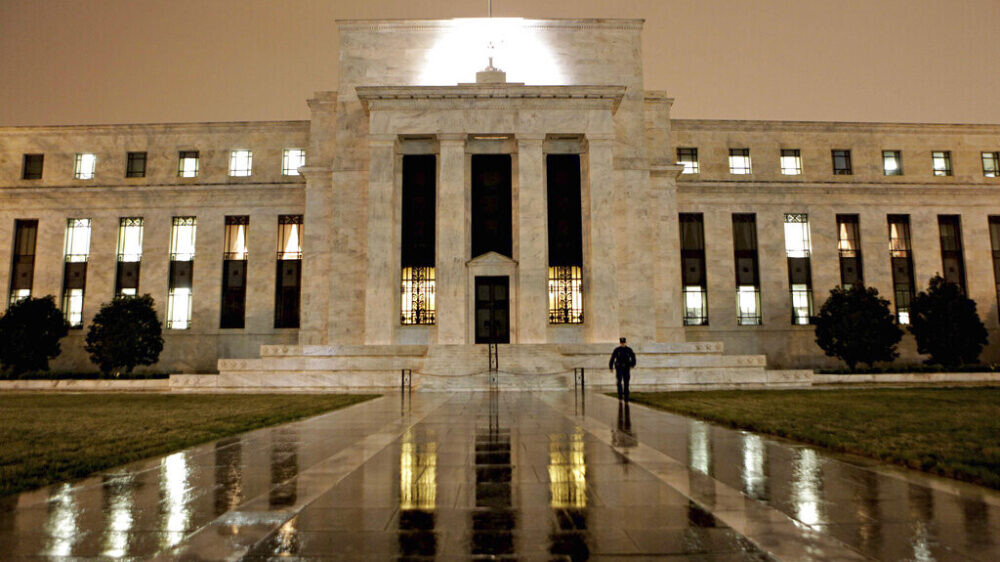
By its decision, the Ministry of Finance showed that it is committed to the Federal Reserve System lowering the key rate (Federal Funds Rate, federal funds rate), Melnyk explained. To increase the repurchase of long-term bonds, the Ministry of Finance will increase the sale of short-term government loans, the rate on which is directly controlled by the Federal Reserve through the Federal Funds Rate.
Thus, the more the Ministry of Finance sells short-term bonds, the more the Federal Reserve will have to buy short-term ones in order to maintain the key rate at the current level.
“You don’t see that angle on the American news. This is a signal to the Federal Reserve for the Federal Reserve to start lowering rates. Or, if he does not want to lower the rate, he will still have to increase the amount of money in circulation by buying short-term government loans. Another signal: let's increase liquidity. If you don't want to do it directly, we will force you to do it. Because we will transfer the debt to a short stage, these auctions will go badly, the Federal Reserve will have to buy them,” the expert added.
All this, however, threatens to accelerate inflation, Melnik noted. He added that its pace will further increase after the end of the escalation in the Middle East.
“The issue is not fundamentally resolved, and no one is really trying to resolve it,” Melnik concluded.
What about the national debt?
Melnik explains the growth of US government debt by the short-term interests of politicians.
“This is a standard problem in any democratic society. If I am in power for the next four years, then I need results in two. I don't need them in 20 years. And, accordingly, after me there may be a flood, as Louis XIV said. Same approach here. And it didn’t start with Trump or Biden – although they, of course, contributed very seriously, especially during the pandemic,” the economics professor noted.
In 1998-2001, the US economy was in surplus, Melnik recalled. There was talk then that within 10 years the United States could completely pay off its national debt. At the end of Bill Clinton's second term, it was 5.7%.
“And then financial analysts spoke about this with horror: how then will we be able to do cash management, how will insurance companies, pensioners, and banks be able to receive state-guaranteed income? And how funny this discussion looks today, when every subsequent president, starting with George W. Bush, has tried to double the national debt,” Melnyk said.