




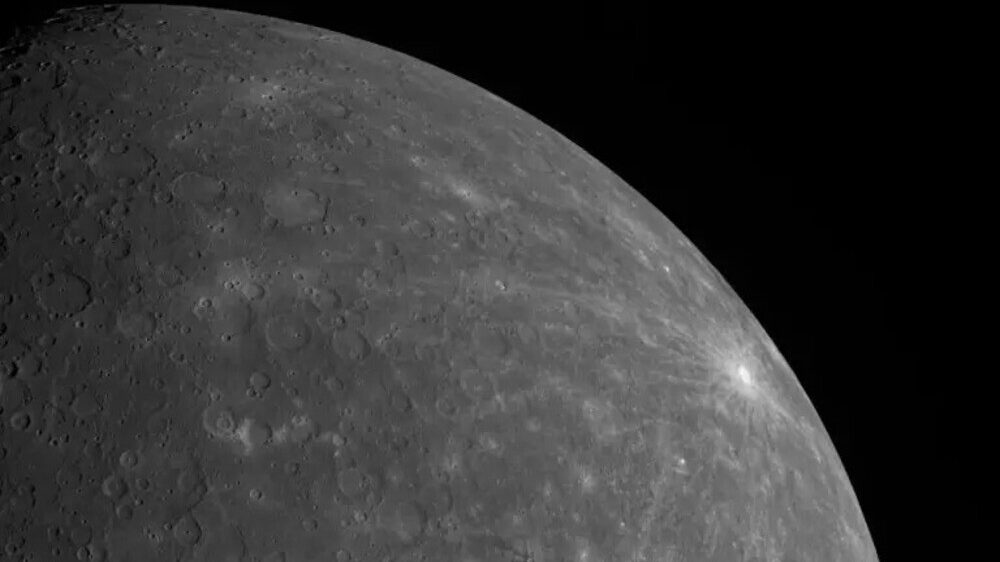

Scientists from the Institute for Space Research at the German Aerospace Center have concluded that Mercury has shrunk more since its formation more than 4 billion years ago than previous calculations had shown. Instead of the expected 8.3 km, the radius of the planet decreased by about 11.6 km, according to the results of a study published in the journal Geophysical Research Letters.
According to NASA, Mercury is the smallest and closest planet to the Sun in the Solar System, which orbits its star in 88 days, which is faster than other planets. Mercury has no moons or rings, but does have a weak magnetic field and a metallic core that occupies 85% of the planet's radius.
“The temperature on the surface of Mercury can be both extremely high and extremely low. Due to the planet's proximity to the Sun, daytime temperatures can reach 800 °F (430 °C). Without an atmosphere to retain heat at night, temperatures can drop to -290°F (-180°C),” NASA said.
The researchers set themselves the task of more accurately assessing how much the radius of Mercury has decreased due to the cooling of its interior. Previously, this was judged by characteristic structures on the surface – ledges and folds that appear when the planet’s crust “wrinkles” under compression. However, the distribution of these structures seemed uneven, and scientists suggested that some of the traces were simply not visible.
To test the hypothesis, they built a global map of Mercury's surface roughness: it reflects how “fresh” and uneven the terrain looks, for example, due to ejecta of rock around young craters. They then compared this map with a catalog of known shortening structures and found a clear pattern – in the roughest areas there were noticeably fewer such structures.
As noted in the publication, this changes ideas about the thermal evolution of Mercury: it cooled more intensely, and its internal structure is likely different from previous models – in particular, we may be talking about a different size and composition of the core. The results of the study can also be used in the study of other celestial bodies in the Solar System.
“Studying surface irregularities along with tectonic landforms can also clarify our understanding of the thermodynamic evolution of the Moon. Mars may also have this ripple effect,” the study notes.
The example of Mercury can teach us about the formation and evolution of large rocky bodies such as Earth, Hannes Bernhardt, an associate research scientist in the department of geological, environmental and planetary sciences at the University of Maryland, College Park, added in a comment to CNN.
Until recently, two missions were sent to the closest planet to the Sun to study it: Mariner 10 in 1974 and MESSENGER in 2004. The first made a flyby of the planet, during which “wrinkles” were discovered on the surface, and the second provided a more complete image of the celestial body, said Bernhardt, who also studied the process of Mercury’s compression, but was not involved in the new study.
For the Earth, compression according to the principle of Mercury is, in principle, uncharacteristic, although some studies have shown that its radius has also decreased by 8-16 km over the past 3 billion years. NASA emphasized in 2011, citing scientists, that the current change in the radius of the Earth does not exceed 0.1 mm per year.
The difference between Mercury is that it is a single-plate planet, while Earth’s lithosphere is divided into moving tectonic plates. Therefore, when Mercury cools, the outer shell contracts entirely, forming ledges and folds, and on Earth, deformations are distributed between moving plates and subduction.
Research on Mercury will be continued in the near future by the joint European-Japanese mission BepiColombo. The main vehicle recently began its arrival phase at the planet after a nearly eight-year journey. By the end of the year, two research stations will be launched into Mercury orbit.