
During its existence, the Solar System has repeatedly passed close to other stars, but only one or two such approaches likely led to its “capture” of objects from alien planetary systems. An international team of scientists modeled this process and concluded that the solar system could receive tens of thousands of interstellar objects, most of them in orbit in the outer part of the Oort cloud, a hypothetical spherical cluster of icy bodies. The research results were published in the journal Astronomy & Astrophysics.
Using the Monte Carlo method, scientists have shown that over the 4.6 billion years of its existence, the Sun has had only a few encounters with other systems that could lead to the capture of interstellar objects. The median number of such events was 1, and the mean was 1.7. It is these encounters that could provide a significant proportion of the captured interstellar objects that are currently in the Solar System.
Such capture of interstellar objects during close flybys of stars is determined by one key parameter – the momentum created by such an approach, the researchers point out. Capture is most likely when this momentum is comparable to the escape velocity of the outermost stable orbit around the star. For the Sun it is about 0.1 km/s. If a passing object is moving much faster, the Sun will not be able to hold it.
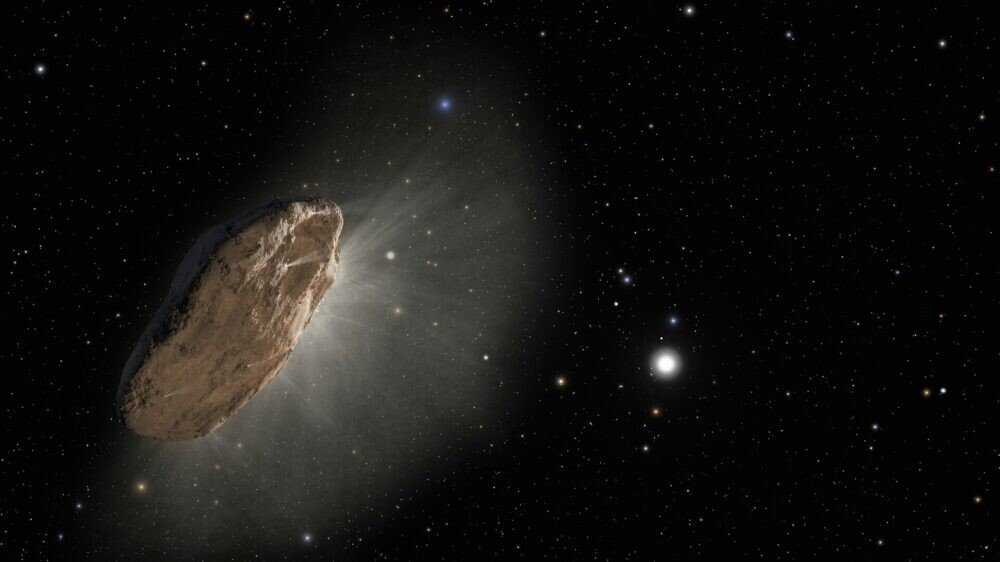
The Sun is estimated to have captured tens of thousands of interstellar objects the size of 'Oumuamua, the first interstellar object recorded to pass through the Solar System in 2017. After it, Comet Borisov was observed in 2019 and 3I/ATLAS in 2025.
Such objects, which have not yet been studied, could end up in the Oort cloud, scientists believe. Moreover, their share in the total population of cloud objects is extremely small – about 10⁻⁸.
Similar rarefied clouds with interstellar objects should exist in other systems, the study authors believe.
“The capture of interstellar objects during close flybys of stars is a universal mechanism that should operate in all stellar systems, regardless of the presence of planets in them. The findings of the study can be extended to other stars: solar-mass stars in the vicinity of the Sun should have approximately the same number of interstellar objects captured in a similar way as in the Solar System,” the study says.
The Oort Cloud is made up of icy bodies and extends up to about three light years from the Sun. Therefore, today it is almost impossible to send a spacecraft there and try to directly detect interstellar objects.