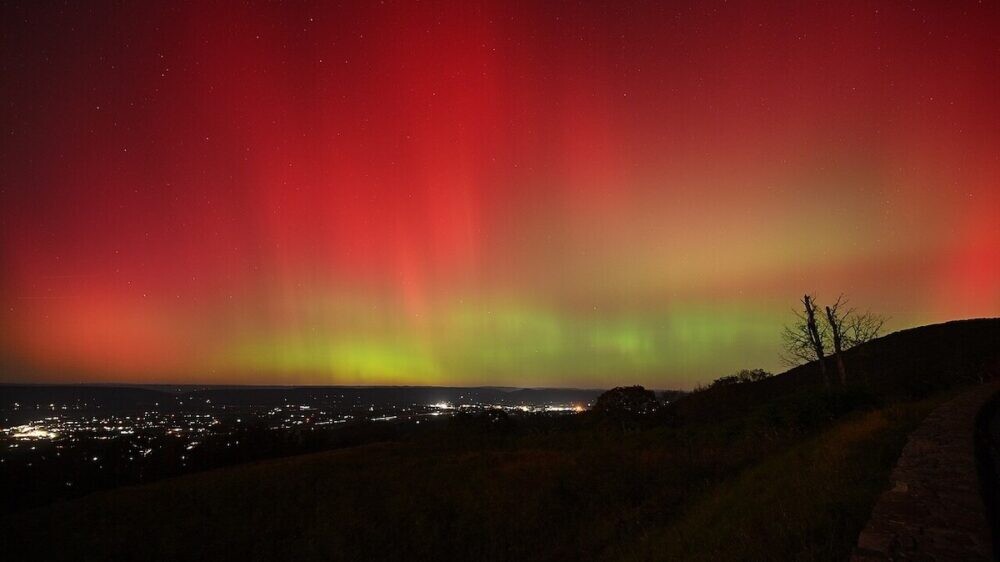

Residents of some areas of the United States on the night of August 27-28 will be able to see two rare celestial phenomena at once – a lunar eclipse and the red northern lights. As astronomer Tom Kerss told Live Science, those in the northwest of North America will be able to catch them together above the same horizon.
The deep partial lunar eclipse will peak at 12:12 pm ET. 96.2% of the Moon's disk will be in the Earth's shadow, which is why it will turn copper or dark red.
The moon will not be considered a “blood moon,” since this characteristic is used during total eclipses, Live Science insists. Another scientific portal Space.com calls the Moon on the night of August 28 “almost bloody.”
Nearly 1 billion people in North and South America, Europe and Africa will be able to see the eclipse in good weather.
As noted by the US National Oceanic and Atmospheric Administration (NOAA), shortly before the eclipse, a geomagnetic storm will begin due to recent coronal mass ejections on the Sun. The northern lights are associated with these processes – the glow occurs when charged particles interact with the Earth's atmosphere.
One way or another, residents of more northern states from New York to Idaho, as well as Northern Europe, will be able to see the lights, but Kerss believes that the unique combination with a lunar eclipse will only be seen in Alaska and some areas of Canada.
“The further west you are, the lower the Moon will be above the eastern horizon during the peak portion of the eclipse. At this moment, it can connect with the brightest part of the oval of the northern lights,” the astronomer emphasized.
According to him, the northern lights on Friday night can be either green or red. The red glow occurs when solar particles interact with oxygen atoms in the upper atmosphere.
Experts also remind that lunar eclipses and northern lights can be viewed without any eye protection. Space.com advises getting ready to watch around 9:30 pm EST, when the lunar disk will begin to darken, albeit subtly at first.