




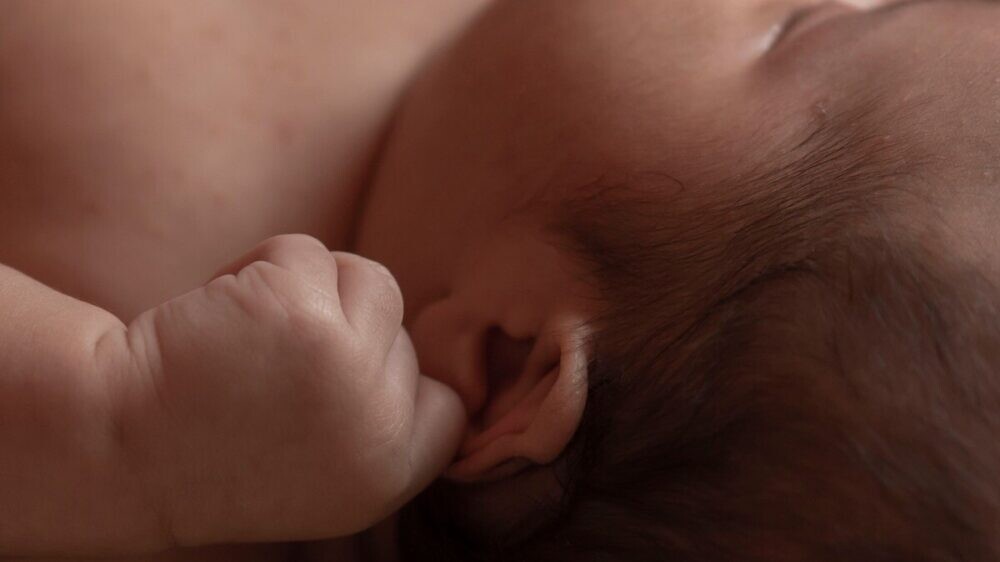

Newborn babies a few days old react to the sounds of crying in the same way as adults react to the sounds of speech, French and Italian scientists have found. The findings, published in the journal Developmental Cognitive Neuroscience of the American Society Flux, were made based on data on the activation of temporal regions of the brain.
The hypothesis of team leader Judith Gervain of the University of Padua and the Paris Center for Integrative Neuroscience and Cognition was that newborns may have a mechanism similar to how hearing and speaking are interconnected in adults.
The researchers wanted to understand how babies' brains react to other babies' cries, whether their reactions differ from those of human speech, and whether the perception of sounds is related to the ability to reproduce them. For the study, scientists composed two groups: 25 children with an average age of 2 days and 27 adults. Both groups listened to recordings of French speech and newborn babies crying.
At the same time, the adults did not know French so that their reaction was similar to the reaction of infants – they perceived only the sounds, not the meaning. The experiment with children took place in the maternity ward of the Necker Hospital, located in the French capital of Paris, and testing of adults was carried out at the University of Padua in Italy.
The research team measured brain activity using non-invasive imaging technology, using caps with special LEDs and sensors to measure changes in blood oxygen levels through the skull.
When certain areas of the brain are activated, they consume more oxygen, allowing sensors to monitor neural responses in the frontal, temporal and parietal lobes of the brain. During the experiment, participants listened to twenty blocks of auditory stimuli: ten blocks contained the sounds of crying, and ten blocks contained spoken sentences.
Each block lasted approximately twenty seconds and contained ten different audio clips presented in random order. There were 25 to 30 second periods of silence in between to give the brain a chance to reset.
It turns out that babies perceive and process speech well, but crying causes a stronger reaction. It activates those parts of the brain that are associated with movement and sound production. At the same time, the sound of speech in infants activates other areas of the brain, scientists emphasize.
“The study demonstrates for the first time that, unlike adults, newborns show increased brain activity in response to crying, a communication signal that is less familiar and complex than speech, but which infants themselves can produce. This suggests that the relationship between vocal responses and auditory perception may emerge early in life,” the scientific publication states.
Thanks to the information received, several cause-and-effect relationships were discovered: crying is the baby’s first and main way of communicating, so newborns themselves can cry, but not yet speak. Because of this, the baby's brain is tuned to those sounds that the child can reproduce independently.
As a result of the experiments, a connection was revealed between the reproduction of sounds and their perception, which, as it turned out, is formed from birth. Moreover, crying plays an important role in the development of speech skills. Based on these data, it is planned to continue research in this area, developmental psychology professor Gervin told PsyPost.
“Continuing this theme, we are now looking at older babies, 6 to 10 months, and seeing how they respond to babble. According to the logic of the current study, children aged 6 to 10 months are just beginning to pronounce words, and their speech, that is, babble, is not yet adult-like, but it is something that they can say themselves, so babble may be especially important for them,” Gervain emphasized.
The researcher noted that her team is currently recording brain activity to track any emerging changes during development. The scientists also plan to take their experiments in several directions: They intend to study how babies react to other types of sounds, such as laughter, to look at how they perceive non-native speech, and to find out how babies react to their own crying.