




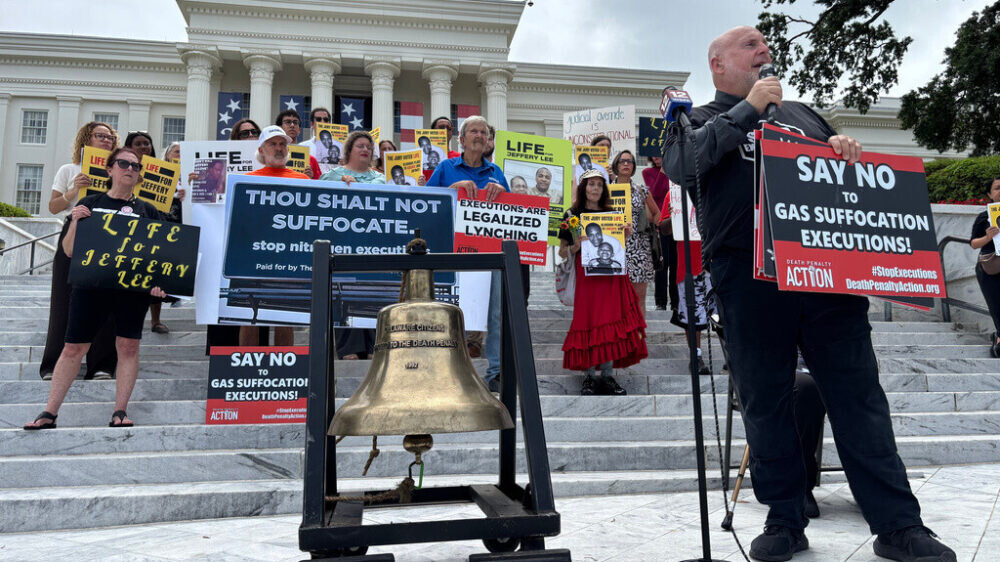

A US federal court on Tuesday banned execute Alabama prisoner Jeffrey Lee using nitrogen gas. The court found that this method violated the constitutional prohibition against cruel punishment. The state prosecutor's office intends to appeal the decision – the case could reach the US Supreme Court, which has never yet recognized any method of executing the death penalty as unconstitutional, reports the Associated Press.
Lee is convicted of killing pawn shop owner Jimmy Ellis and store employee Elaine Thompson. According to prosecutors, on December 12, 1998, Lee burst into a pawn shop near Orrville with a sawed-off shotgun and fatally shot both victims.
During the trial, 7 of 12 jurors voted to sentence Lee to life imprisonment. However, the judge took advantage of the then-current practice of judicial override and sentenced the prisoner to death. Alabama ended the practice in 2017, and judges can no longer impose capital punishment over a jury's decision.
Lee's lawyers argue that execution using nitrogen gas causes undue suffering. In recent cases, the parties have argued over how painful such a death is, how long the condemned person remains conscious, and whether convulsions during the procedure indicate suffering or are an involuntary reaction of the body. CBS News previously reported that the latest execution by strangulation in Alabama lasted more than 30 minutes.
The procedure itself boils down to putting a respiratory mask on the face of the convicted person, through which pure nitrogen is supplied. As a result, a person dies from hypoxia – lack of oxygen.
It is noteworthy that back in May, federal district judge Emily Marks concluded that the use of nitrogen hypoxia does not violate the Eighth Amendment to the US Constitution. However, this week she gave the opposite decision, guided by the position of the Court of Appeal. On Monday, a three-judge panel of the 11th U.S. Circuit Court of Appeals ruled that the current execution protocol creates a “substantial risk of serious suffering.” The judges noted that the period of up to three minutes during which a convicted person could remain conscious after nitrogen was started was “unacceptably long.”
At Tuesday's trial, Marks stressed that her decision does not overturn Lee's death sentence. The state may use an alternative method of execution suggested by the prisoner himself: firing squad. She also recalled that in Alabama there are still two permitted methods of executing the death penalty – injection and the electric chair. She said Lee “has no right to seek an injunction against execution using one of these methods.”
The legal battle, however, is not yet over. State Attorney General Steve Marshall's office filed an appeal Tuesday evening. If unsuccessful in the appellate court, the authorities will be able to seek a review of the case in the US Supreme Court, WBMA notes.
Formally, the decision applies only to Jeffrey Lee. However, lawyers for other death row inmates are likely to cite this precedent in similar trials.
“This is the first time in modern history that a method of executing the death penalty has been declared unconstitutional. I consider this a landmark decision that will have significant implications for the legal regulation of the death penalty,” said Bernard Harcourt, a professor at Columbia Law School.
Lee is currently being held at Holman Correctional Facility in Atmore. His execution was scheduled for Thursday, but following the court's decision, execution will most likely be postponed until the appeal stage is completed.
The method of execution using nitrogen began to be used in the United States in 2024. It is legal in five states, but has only been used in practice in two—seven times in Alabama and once in Louisiana.