




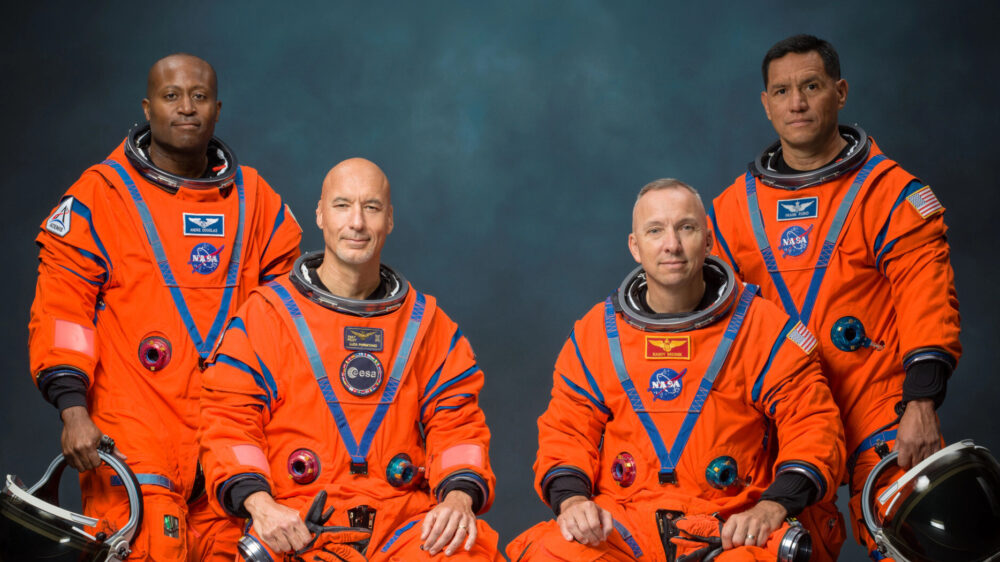

The National Aeronautics and Space Administration (NASA) introduced the crew members of the future Artemis III mission (“Artemis 3”). In 2027, they will practice docking the Orion spacecraft with two lunar landers in low Earth orbit as part of a program to return humanity to the surface of the Moon.
The crew will include commander Randy “Comrad” Bresnik, Italian pilot Luca Parmitano and mission specialists Frank Rubio and Andre Douglas. Robert Hines was appointed as backup crew member.
Bresnik, 58, is a former fighter pilot who spent 149 days in space during a shuttle flight in 2009 and an extended stay aboard the International Space Station (ISS) in 2017.
Parmitano, 49, is an astronaut with the European Space Agency. He was the first Italian to command the ISS. He performed two spacewalks and also trained as part of a joint program with the United States to fly jet aircraft.
Douglas, 40, is a test engineer and commander in the U.S. Coast Guard Reserve. This will be his first space flight. He was also a reserve crew member for the recently completed Artemis II lunar flyby.
Rubio, 49, is an Army Black Hawk helicopter pilot and a general practitioner. In 2022-2023, he spent a record 371 days in space for the United States aboard the ISS, where he arrived together with Roscosmos cosmonauts Sergei Prokopyev and Dmitry Petelin on the Soyuz MS-22 spacecraft.
Hines, 51, is an instructor and test pilot with more than 20 years of experience. He spent 170 days in space and was the pilot of NASA's Crew-4 mission to the ISS.
The goal of the Artemis program is to return human presence to the Earth's satellite for the first time since the Apollo 17 mission in 1972, as well as to create a permanent platform for preparations for flights to Mars. RTVI.US previously talked about what the lunar base that NASA is building will be like.
The second mission of this program ended in April 2026. Then the astronauts conducted the first manned flight around the Moon in 50 years, during which they tested the operation of the systems and equipment of the Orion spacecraft, intended for future expeditions and landing on the surface of the satellite.
Based on this data, two commercial landers from SpaceX and Blue Origin will be tested as part of the third mission. For the first time, NASA will coordinate the launch of multiple spacecraft, said Jeremy Parsons, acting deputy associate administrator for the Moon to Mars program in the space agency's Exploration Systems Development Directorate in Washington.
The procedure will help understand how Orion, the crew and ground teams interact with the equipment and commands of both lander manufacturers before astronauts are sent to the surface of the earth's satellite, he explained.
“Although this is a low-Earth orbit mission, it is an important step towards a successful Artemis IV lunar landing. Artemis III is one of the most complex missions NASA has ever undertaken,” Parsons said.
The mission is planned to perform a number of tasks to demonstrate critical systems needed for future landings. The SLS (Space Launch System) rocket will launch Orion with four crew members into orbit, and the European service module will provide thrust for insertion into a circular orbit. The crew will spend more time aboard the ship to evaluate life support and docking systems. After all the tasks are completed, he will return to Earth, where he will carry out splashdown.
The original goal of Artemis III was the first crewed landing on the Moon since the Apollo 17 mission in 1972. However, concerns about Orion's heat shield and delays in the development of other systems prompted NASA to change the goal of the current flight. Further landing will already be a task for the fourth mission
After receiving all the results of the third stage of the program, at the beginning of 2028, Artemis IV is planned to enter lunar orbit, where the crew will transfer from Orion to a commercial lunar lander for descent to the surface of the Earth’s satellite. Further, from the end of the same year, already during the Artemis V period, it will be actively explored and equipped for the permanent presence of humans.