



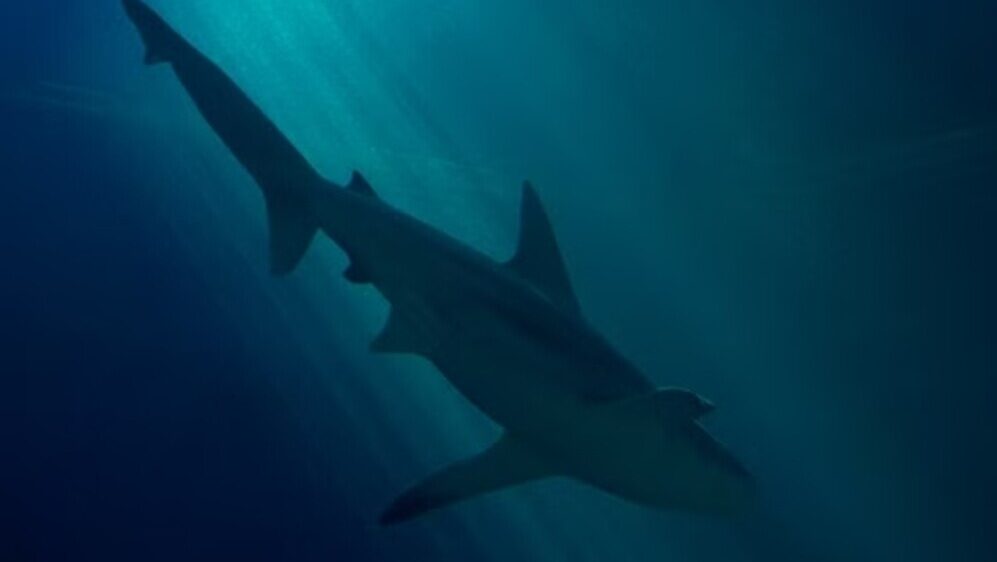

A rare species of goblin shark (Mitsukurina owstoni) has been recorded in its natural habitat for the first time, a team of scientists from the United States and Australia reported in a study published in the Journal of Fish Biology. Videos of one of the oldest deep-sea predators were made in 2019 and 2024, and now for the first time they have been confirmed using scientific methodology, experts noted.
“Goblin sharks” are sometimes called “living fossils” because they are the only living members of their family, a genus of sharks that dates back nearly 125 million years, notes EurekAlert.
“In the past, ‘goblin sharks’ were filmed and described only after they were caught and brought to the surface, where they could be seen by divers and where they soon died,” the scientific service clarifies.
In the new study, the scientists noted that the confirmed videos suggest that Scapanorhynchus is more widespread than expected and at more varied depths.
The first recording of a “goblin shark” in its natural habitat was made in 2019 using a remotely operated vehicle near Jarvis Island, a US territory in the Pacific Ocean. The equipment was installed on an unnamed seamount from the research vessel EV Nautilus.
When experts first saw the shark at a depth of about 0.75 miles (1.2 km), they didn’t know what kind of animal it was, one of the study’s authors, Steve Oskavich, Ph.D., of the Division of Invertebrate Zoology at the Smithsonian Institution’s National Museum of Natural History, told ABC News.
A rare deep-sea goblin shark has been observed alive in its natural habitat for the first time, according to new research
Until now, living goblin sharks had only been documented after being caught on fishing lines and brought to the surface
pic.twitter.com/mYiDCqkVtE— Nature is Amazing ☘️ (@AMAZlNGNATURE) June 13, 2026
The second time a baited camera installed in collaboration with the University of Western Australia recorded a deep-sea shark on the slope of the Tonga Trench, about 1,250 miles (2,000 km) southwest of Jarvis Island, was in 2024.
Scientists now hope to photograph the shark more than once – this is necessary for further study of habitat preferences and assessment of its conservation status.
“Goblin sharks” got their nickname because of their appearance – unique jaws and a large rostrum, which is essentially the shark’s nose.
Aaron Judah, a graduate student at the University of Hawaii at Manoa, told ABC News that the rostrum is covered in what are known as ampullae of Lorenzini, specialized sensory organs filled with a gel that conducts electricity and allows predators to search for squid, fish and crustaceans in the dark.
“I was shocked because this species is not usually found in the central Pacific Ocean, which means the animal’s range has expanded significantly,” Judah added.
Earlier, RTVI.US reported the first video recording in the Mediterranean Sea of an adult white shark underwater in its natural habitat and the discovery of rare dark sharks, which were considered an almost extinct species, off the northeastern coast of the United States.