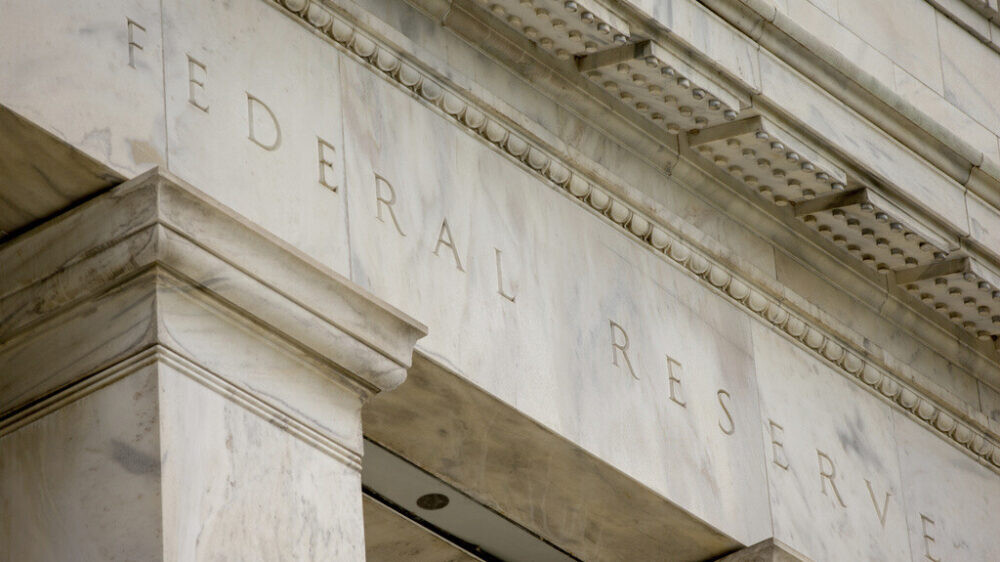

Slowing inflation in the United States reduces the likelihood of the Federal Reserve System (FRS) raising the key rate, but the worsening situation in the labor market is becoming increasingly important for the regulator’s future decisions. In July, the American economy lost 23,000 jobs, while for normal growth it needs to create about 150,000 monthly, Mikhail Melnik, economics professor at Kennesaw University in Georgia, told RTVI. In his opinion, in September the Fed will most likely keep the rate at 3.5-3.75%, and by the end of the year or at the beginning of the next it may move to lower it.
The Consumer Price Index (CPI) rose a seasonally adjusted 0.1% in July, the US Bureau of Labor Statistics reported this week. The core CPI, which excludes food and energy prices, increased 0.2%. In annual terms, overall inflation was 3.4%, and core inflation was 2.5%. Both indicators decreased by 0.1% compared to June.
According to Melnyk, the July inflation data did not come as a surprise. Although the level is still well above the Fed's target of 2%, the moderate rise in prices in July following similar dynamics in June indicates a weakening of inflationary pressure caused by higher energy prices at the beginning of the year.
“Inflation slowed in July mainly due to lower gasoline and energy prices: in July, prices in the energy sector fell by 1.5% over the month, which helped stabilize the overall figure. For example, 87 gasoline now costs about $3.89 per gallon in Atlanta,” he noted.
Melnik named the cooling of the global economy as another reason for the slowdown in inflation.
“Back in March, I said that regardless of developments in the Middle East, inflation in the United States would slow significantly in the summer. The main reason is a significant slowdown in economic growth,” he said.
One of the most obvious signs of a slowdown in growth, according to the expert, was the situation on the labor market. The U.S. economy lost 23,000 jobs this month, with the private sector adding about 30,000 while the public sector was down about 53,000.
“Such dynamics can hardly be called positive. The American economy needs to create approximately 150,000 jobs each month to employ a growing population,” Melnyk said.
The expert doubted that the Fed would raise the key rate in September. According to him, inflationary pressure is gradually weakening along with a decline in economic growth. Moreover, the situation may develop in the opposite direction: the likelihood that by the end of this year or at the beginning of the next the Fed will lower the rate, according to its estimates, is higher than the likelihood of raising it.
“Rate increases are used primarily to cool an overheated economy, not to punish an economy that is suffering from inflation caused by external factors,” he argued.
Since the 2008 crisis, the Fed's approach to monetary policy has changed significantly. These changes have had a major impact on the tools the regulator uses today. The key rate, as the expert noted, in the modern monetary system itself no longer has the meaning it had before, and in some circumstances changing it may even be counterproductive.
To understand the current monetary policy, according to the expert, it is important to monitor not only the rate, but also the balance of the regulator – in particular, what is happening specifically with the injection or withdrawal of currency from circulation.
“The Fed does not lower the key rate, but at the same time continues to print money and inject it into the economy, buying long-term government bonds – two-year, five-year, ten-year, etc. Thus, the Fed continues to inject money into the economy and thereby adjusts and stops the rise in the cost of long-term borrowings, which determine rates on business loans, mortgages, car loans, and so on,” he noted.
Let us remind you that in May, the new head of the Federal Reserve, Kevin Warsh, was sworn in at the White House – he was nominated by US President Donald Trump, thereby hoping to achieve a reduction in the key rate. At the same time, as RTVI.US said, a number of investors, on the contrary, believed that the Fed’s next step should be to increase it.
On June 17, the first meeting of the Fed was held under the chairmanship of Warsh – at which the regulator kept the rate at 3.5-3.75%. The Fed statement noted that the United States is experiencing positive economic dynamics: labor productivity is rising, investment in production is increasing, and the number of jobs corresponds to the growth in the number of workers. Separately, it was reported that inflation remained above the Fed's target, prompting the Federal Open Market Committee to say it would “ensure price stability.”