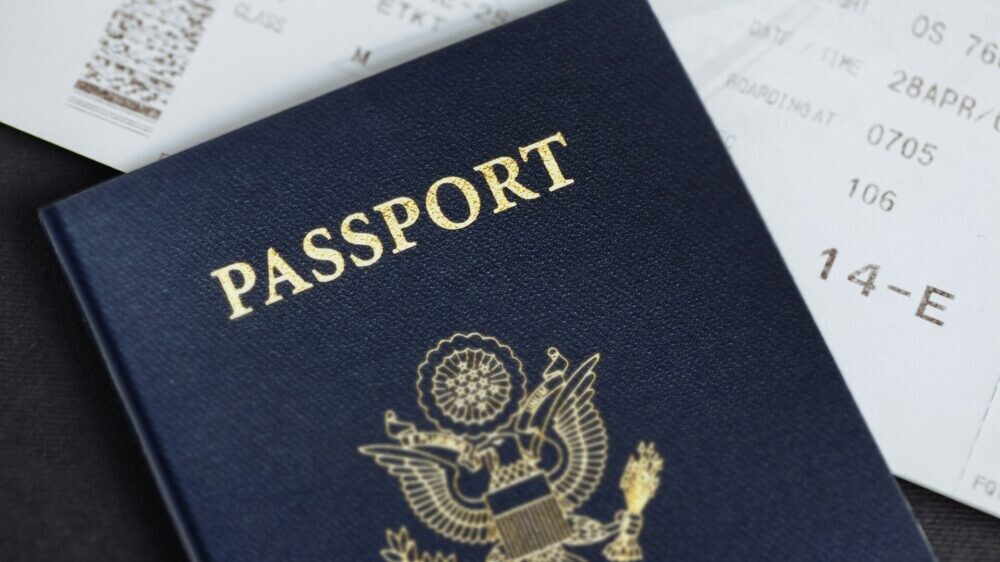

The USA was in tenth place in the list of the most powerful passports in the world, although 20 years ago it occupied the first line of the ranking, should from a new report by the international consulting company Henley & Partners. Since some states share the same position with the same result, in fact the American document was inferior in the new analysis to the passports of 36 countries.
The index of a passport is determined by the number of countries and territories that its holder can visit without first obtaining a visa. The more destinations available without a visa or with the possibility of a visa on arrival, the stronger the passport is considered, Newsweek notes.
“The most powerful passports belong to states that other countries want to be their partners – in trade, investment and security. Ultimately, mobility serves as an indicator of how highly other states value relations with a particular country,” said Christian Kälin, head of Henley & Partners and creator of the Henley Passport Index.
The latest report shows that in two decades, the US passport has dropped from first place to tenth – in 2006, the United States topped the list with Denmark and Finland, and in 2026 it was tied with Iceland.
US passport holders can currently visit about 179 countries without first needing a visa. This provides access to approximately 92% of the world's countries, but citizens of more and more countries have access to a wider choice of travel destinations.
In recent years, several countries have tightened entry rules for Americans. Thus, in 2025, the agreement with Brazil ceased to operate, as a result of which citizens of both countries now need to obtain visas. Venezuela ended visa-free travel for Americans in 2007. Over the past two decades, Türkiye, Myanmar and Ghana have also introduced visa requirements.
Singapore in first place and UAE with record growth
The first place in the 2026 ranking is occupied by Singapore: its citizens can visit 192 destinations without a visa. This is 70 more than in 2006, when the country was in eighth place.
The United Arab Emirates has made the fastest rise in the ranking over the past 20 years. The state moved from 62nd place to second, which it now shares with Japan and South Korea. Passport holders of these countries have access to 188 destinations.
Third place is occupied by Sweden, whose citizens can visit 187 countries without a prior visa. In 2006, the Swedish passport was in second place and provided access to 129 destinations.
Fourth place in the ranking for July 2026 is shared by Belgium, Denmark, Finland, France, Germany, Ireland, Italy, Luxembourg, the Netherlands, Norway and Spain. Holders of passports from these countries can freely enter 186 countries.
Malta improved its tally to 185 destinations and took fifth place along with Austria, Greece, Portugal and Switzerland. In 2006, Malta was not included in the top ten, occupying 11th place.
The Peace Index and the Power of the Passport
The report's authors found a consistent positive relationship between a country's Global Peace Index ranking and the strength of its passport. As a rule, citizens of more peace-loving countries have more opportunities for visa-free travel.
However, there are notable exceptions – countries whose passports are much stronger than their situation would suggest given their crime rates, political stability and state involvement in conflicts.
Thus, despite the United States being ranked 134th on the Global Peace Index list, the American passport remains the tenth most powerful in the world. Israel, which, according to the compilers of the index, is one of the five least peace-loving states, ranks 18th in the passport rating.