


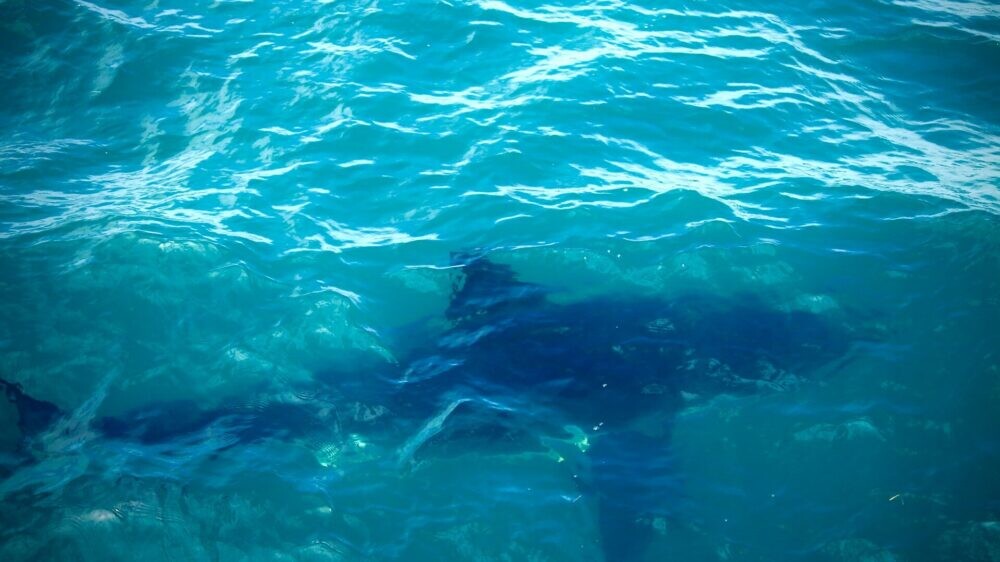

The number of white sharks, especially juveniles, may increase off the California coast, Spectrum News reports. Their migration is affected by rising water temperatures in the Pacific Ocean associated with the El Niño climate phenomenon. In search of cooler waters, predators move from Baja California in Mexico north along the coast of the American state, where they can remain until winter.
El Niño is a natural climate cycle that causes temperatures in the central and eastern equatorial Pacific Ocean to be at least 0.9°F (0.5°C) above normal, AccuWeather reports. This occurs due to the weakening of the trade winds, which usually bring cold water to the surface.
On June 11, the US National Oceanic and Atmospheric Administration (NOAA) announced the formation of El Niño in the tropical Pacific Ocean and issued an official warning (El Niño Advisory). According to forecasts, the phenomenon may reach a level of moderate to severe intensity by the fall. There is a 63% chance that ocean surface temperatures will be more than 3.6 °F (2.0 °C) above normal. In this case, NOAA classifies the event as a Very Strong El Niño.
According to The Guardian, young white sharks up to nine feet long (about 2.7 m) regularly migrate from Baja California north along the state's coast. They prefer to stay close to the shore, where they feed on fish, stingrays and squid. These coastal areas allow them to grow safely before moving into deeper waters. However, due to El Niño, young sharks in large numbers are moving further north, where they can remain until the end of the year.
Predators have begun to leave the warming waters of Mexico, so their numbers off the coast of California may increase significantly by the end of summer. Already this season may see one of the largest concentrations of white sharks in the last ten years, notes The Guardian.
In 2015, when El Niño was comparable in strength to the current event, scientists recorded twice as many white sharks as usual off the California coast. There were so many of them that a kind of “shark nursery” was formed in the Monterey Bay area.
Researchers at the University of California, Santa Barbara recently tracked white sharks using a drone. They counted about six individuals near one of the beaches, some of which were swimming very close to the surfers.
Despite the increase in predator numbers, shark attacks in California remain extremely rare. According to the state Department of Fish and Wildlife, only 250 such incidents have been reported since 1950, of which 17 resulted in fatalities. The number of fatal shark bites, about 2.5 per decade, remained relatively stable over this period.
Even if El Niño brings more sharks closer to shore, people and predators could be close together without posing a serious threat to each other, said Douglas McCauley of the Benioff Laboratory of Ocean Sciences at the University of California, Santa Barbara.
Years of drone observations have shown that sharks may be curious, but do not mistake humans for prey: they swim up to surfers and swimmers, inspect them, and then move away.
“One of our most impressive observations is that surfers, swimmers and people on paddle boards often get very close to the shark. The shark swims up, looks around and continues on its way. Nine times out of ten, people don’t even notice it,” McCauley said.
In one study, scientists recorded the sounds made by surfers, swimmers and people in kayaks, and then played them back in shark areas. The animals showed little reaction to the sounds of surfers and kayakers, but showed interest in the swimmers. Presumably, they were attracted by the combination of striking the water with their hands and moving their legs.
The sharks approached the source of the sound, swam to about 10 feet (about 3 m), and then turned around and swam away.
“We concluded that sharks are likely capable of distinguishing humans from their usual prey. We don't smell like food, don't sound like food, and don't look like food, so they don't think of us as food,” said Chris Lowe, director of the Shark Laboratory at Cal State Long Beach.
At the same time, scientists do not yet have sufficient data that would explain why sharks sometimes still attack people. According to the most common version, during unprovoked attacks, a predator may mistake a person for another prey.
“If you see a very large shark, it is better to get out of the water and play volleyball on the beach. The same should be done if the shark behaves unusually: it does not just swim past, looking around, but moves chaotically or circles around you. In such a situation, it is better to return to shore,” McCauley said.